
2. From the Smith take a view of what Instruments is born in Coats Armor, which is used by his Brother the Farrier, and they are such as these.
Barnacles
 XXV. He beareth a pair of Barnacles.
These are called also,
Horse Twichers, or Bracks: which are used to put
on Horses Noses, when they will not stand quietly to be
Shooed, Blooded, or Dressed of any sort of sore, or such
like occasions: for although the nature of the Horse is
not to be tame, yet this Instrument made by Art, maketh
him obedient.
XXV. He beareth a pair of Barnacles.
These are called also,
Horse Twichers, or Bracks: which are used to put
on Horses Noses, when they will not stand quietly to be
Shooed, Blooded, or Dressed of any sort of sore, or such
like occasions: for although the nature of the Horse is
not to be tame, yet this Instrument made by Art, maketh
him obedient.
Pincer barnacles
 XXVI. He beareth a pair of Pincer-Barnacles. These are termed so, to distinguish
their form from the fore-going; this having handles at
them like Pincers, to hold a Horse with ones hand by
them, whereas the other is bound to his Nose, with a
Lace or Cord.
XXVI. He beareth a pair of Pincer-Barnacles. These are termed so, to distinguish
their form from the fore-going; this having handles at
them like Pincers, to hold a Horse with ones hand by
them, whereas the other is bound to his Nose, with a
Lace or Cord.
Barnacles
 XXVII. He beareth a pair of Brackes, or
Barnacles. This is a third sort of Barnacles,
which if you take notice, differs from the first, though
but very little; for this is held together at the top by a
Ring inclosing the Buttons; the first having the top Buttons held together by an Iron Pin ravetted through
them.
XXVII. He beareth a pair of Brackes, or
Barnacles. This is a third sort of Barnacles,
which if you take notice, differs from the first, though
but very little; for this is held together at the top by a
Ring inclosing the Buttons; the first having the top Buttons held together by an Iron Pin ravetted through
them.
Roller barnacles
 XXVIII. He beareth a pair of Roller Barnacles Corded. Some term them
Wood-Twitchers, being only two Roller of Wood
bound together with the Horse Nose between them, which
for want of better serveth in place of Iron Barnacles.
XXVIII. He beareth a pair of Roller Barnacles Corded. Some term them
Wood-Twitchers, being only two Roller of Wood
bound together with the Horse Nose between them, which
for want of better serveth in place of Iron Barnacles.
Barnacles

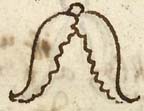
 XXIX. He beareth two Barnacles:
in Chief another Extended (or laid open).
for another sort numb.31.
XXIX. He beareth two Barnacles:
in Chief another Extended (or laid open).
for another sort numb.31.
Smith's file types
 XXX. He beareth a File (or a Smiths
File) between an Horse-lock Key, and a Farriers
Buttrice.
XXX. He beareth a File (or a Smiths
File) between an Horse-lock Key, and a Farriers
Buttrice.
First the File is an Instrument used by Smiths for the cutting off, and smoothing of the Irregularities and Hammer stroaks, made in the Forging out of any Smiths work: and for the several sorts of Work, there is different sizes of Files, big and little: even from two Inches square, With length answerable to them as small as a Wyer: and besides there are of them of divers forms and fashions; as round Files, half round, three square, and flat Files; which have their denominations answering their form: but from the roughness, and smoothness of their cutting, and from their use in Work they have other names: as,
The Common, or Rough File, called a Rubber: It is cut with large and deep Teeth, to take off the first roughness of any Forged piece of Iron Work.
The using File, is a long and broad File, exactly flat on both its cut, or teeth sides: but the teeth not half so rough as the common File: with this work is made more smoother and brought to a nearer perfection.
The Jack File, is a broad File somewhat thin in both edges, and stronger in the middle: with this Jack Wheels have their Teeth cut in them.
The smooth File, this makes work smooth and fine, and ready to the pollishing: and hath the teeth cut very ebb and fine upon it as if were almost plain.
Thus you see Files are of several cuts, for the Rough toothed File cuts faster than the Bastard toothed File; and it, faster then the Fine toothed File: one succeeding another, till the Work is so smooth as can be Filed, yet it may be made smoother with Emerick, Tripoi, and such things.
Buttress
 The Buttrice, is that wherewith the Smith pierces
the Sole that is over grown, and the hoof of a Horse: to
fit the Shoe to it, and to cut of the skirts of the said Sole,
which over casts the Shoe, making both even.
The Buttrice, is that wherewith the Smith pierces
the Sole that is over grown, and the hoof of a Horse: to
fit the Shoe to it, and to cut of the skirts of the said Sole,
which over casts the Shoe, making both even.
Horse lock key
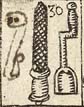 Image from proof plate
The Horse-lock Key, is for the opening of a Horse or Fetter-lock, and therefore is more, and generally by Countrey Men termed a Fetter-lock, or Chainlock Key. It is an Iron Plate square bent at one end, having a square hole and nicks in that part of it, to answer the Springs and Wards within the Bolt: the other end is bent half round, with a small turn at the end, to make it look handsome.
Smith's tongs
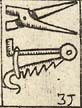 Image from proof plate
XXXI. He beareth a pair of a Smiths Tongs, and a pair of single tooth Barnacles. These Tongs goe under diverse Denominations, some term them, Smiths Tongs, others Smithy Tongs, and Forging Tongs, but generally they are called straight nosed Tongs: to distinguish from another pair which they commonly used, called the crooked Nosed Tongs in numb.129. The first used to hold in the Fire short things, or whatsoever is flat, as Plate Iron. The latter used for the Forging of small Barrs, and such Work as will be held between their Chaps: in which there is these terms, as
The Chaps, which is the holding part.
The Joynt, and Ravet, the place where it turns to open and shut.
The Handles, by which the Smith holds them.
Barnacles
 These are another sort of Barnacles, which have
the Teeth on the out side, being made stretter, or loser
by the running of a Ring higher or lower, on the Teeth
towards the Joynt, see the others numb.25. to 29.
These are another sort of Barnacles, which have
the Teeth on the out side, being made stretter, or loser
by the running of a Ring higher or lower, on the Teeth
towards the Joynt, see the others numb.25. to 29.
Hand vice
 XXXIV.[sic] He beareth a Hand-Vice.
There are two sorts of Hand Vices, the one called the
Broad Chapt Hand Vice, having the same Chaps as
the Large Vice fixed to the Smiths Board hath: as
numb.49. 128. The other is called, the square Nosed Hand Vice, which is this:
XXXIV.[sic] He beareth a Hand-Vice.
There are two sorts of Hand Vices, the one called the
Broad Chapt Hand Vice, having the same Chaps as
the Large Vice fixed to the Smiths Board hath: as
numb.49. 128. The other is called, the square Nosed Hand Vice, which is this:
Now the Office of both are to hold small Work in, which in the Fileing requireth often turning about. The latter is seldom used but for Filing of small Gobulous Work, as the heads of Pins, that round off towards the edges. The several parts of these Vices are these following.
The Face, the top part of it.
The Chaps, the holding part, which is nicked or cut with a Bastard cut.
The Screw-pin, which is cut with a Worm or Thread.
The Nut, or Screw-Box, which hath also a Worm in it.
The Spring, which forceth the sides to open, being unscrewed.
The Joynt and Rivet at the bottom, on which it turns in the opening and shutting.
H hinge
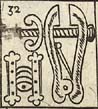 Image from proof plate
In this quarter I have set another form of an H hinge, of which see more numb.22.
Planishing anvil
 XXXIII. He beareth a Planishing Anvil.
Others term it a smooth faced, or a square
Anvil; on such an one set in a Hole in the Smith-Bench,
he points and straightens his Horse shooe Nails when he
is about to use them, thereby beating off all the loose
Scales which cleave to the Nail.
XXXIII. He beareth a Planishing Anvil.
Others term it a smooth faced, or a square
Anvil; on such an one set in a Hole in the Smith-Bench,
he points and straightens his Horse shooe Nails when he
is about to use them, thereby beating off all the loose
Scales which cleave to the Nail.
 Previous section
 Next section
