
12. There are such variety of these Tools and Instruments pertaining to the Iron Workers, and made works of iron, that it is impossible to Learn out the Thousandth part of them; what I have mentioned before, let these out of a Candid respect to their wants, be added as a Supplement to chap.7. numb.1.
Washer
 Image from proof plate
CXXVII. In this quarter are three things very useful and necessary about a Smiths Forge, which may be thus Blazoned a Washer between a Slice and an Hearth Staff, and may be a proper Coat or Devise for him that hath risen by the Forge or working in the Fire.
The Washer is a Bundle of Rushes set in an Iron, with an Iron Stail to it; with this Water is sprinkled out of the Trough into the Fire to make it burn the hotter; and also to sweep up the scattered Coals up to the Fire.
Slice
Image from proof plateThe Slice, is a broad Iron Plate like a Shovel, with an Iron handle; with this they shovel up Coals to the Fire, and clap the Fire close together.
Hearth staff
Image from proof plateThe Hearth Staff, is a long round piece of Iron with a round head, and something sharp at the further end; it is to open and stir up the Fire, and cast out Cinders that come from the Iron, that the Fire may Burn the better.
Hammer types
 CXXVIII. In this quarter are three necessary Instruments belonging to the Black-smith, the Hammer,
the Screw Pin, and the Vice.
CXXVIII. In this quarter are three necessary Instruments belonging to the Black-smith, the Hammer,
the Screw Pin, and the Vice.
The Hammer hath several names, according to its bigness, yet all after this form and fashion: The first and least is the Rivetting Hammer, it is very rarely used at the Forge, unless the Work be very small; but upon cold Iron it is used for Rivetting, or setting streight, or crooked, small works.
The next is the Hand-Hammer, which is bigger or lesser, according to the strength of the Workman; but it is a Hammer of such weight, that it may be welded or governed with one hand at the Anvil.
The third is termed the up-hand Hammer, or up-hand Sledge, of some termed the Fore-Hammer; it is used to indifferent or middle sort of Work, wherein the under Workman, seldom lifts this Hammer higher than his head,
The fourth sort of Hammer is the about Sledge, or the Smiths great Forging Hammer; he that useth this, holdeth the further end of the Hammer in both his hands, and swinging it about his head, he at Arms length lets it fall as heavy a Blow as he can upon the Work that is to be Battered or Drawn out. All these sorts of Hammers have no claw or slit in the Pen, as those that are for drawing out of Nails, as chap.7. numb.1.
Parts of the Hammer.
The Face, that part it is beaten with.
The Pen, is the small end of it.
The Eye, the hole into which the handle is put.
The Head, or Hammer Head, is all the Iron part.
The Cheeks, or Plates, or Tangs, the Irons
which hold the Head on.
The Handle, is the Wood by which it is held.
The Hammer, when it is all furnished and made
compleat.
Screw pin
 The second, is the Screw Pin, of some termed a
Tap: Some Taps are made Taper, others not; with
the help of this Screw is forced and turned or cut in
an hole of an Iron Plate, to receive a Screw-pin.
The second, is the Screw Pin, of some termed a
Tap: Some Taps are made Taper, others not; with
the help of this Screw is forced and turned or cut in
an hole of an Iron Plate, to receive a Screw-pin.
Bench vice
 The third is the Vice, called the Bench Vice, because set up very firm to a Bench that it shake not, but
stand upright; this holdeth all sorts of Iron work that
requires Fileing. In it there are several parts and Members which are termed by Workmen as followeth.
The third is the Vice, called the Bench Vice, because set up very firm to a Bench that it shake not, but
stand upright; this holdeth all sorts of Iron work that
requires Fileing. In it there are several parts and Members which are termed by Workmen as followeth.
Related text(s)
Bench vice parts
Crooked nose tongs
 CXXIX. Hath in it the Smiths Tools called the Crooked Nose Tongs, the Drill, and the
Screw Plate, of which in particular.
CXXIX. Hath in it the Smiths Tools called the Crooked Nose Tongs, the Drill, and the
Screw Plate, of which in particular.
First, the Crooked Nose Tongs, these have their
chaps placed near the Joint, because that considering the
length of the handles, they hold the Iron faster than
they could do, were they placed farther from the Joint:
These kinds of Tongs are for to hold small Bars, or such
thicker work as will go between the Chaps. In these Tongs there is
The Chaps.
The Joynt.
The Rivet.
The Handles.
Drill
 The second is the Drill, it is a shaft or long Pin of
Iron with a Steel point, much like a Spear head, the other
end round; on the middle of it is fastned a Barrel
like a Jack Barrel. There are Drills of several sorts according to the bigness of the work; they are used for
the making of such holes as Punches will not conveniently do, as in the shank of a Key and such like. The Drill,
the Drill Bow, and the Drill Plate, go all together
as one entire Instrument of three parts; but for two of
them see the next following Figure. In the Drill
there is
The second is the Drill, it is a shaft or long Pin of
Iron with a Steel point, much like a Spear head, the other
end round; on the middle of it is fastned a Barrel
like a Jack Barrel. There are Drills of several sorts according to the bigness of the work; they are used for
the making of such holes as Punches will not conveniently do, as in the shank of a Key and such like. The Drill,
the Drill Bow, and the Drill Plate, go all together
as one entire Instrument of three parts; but for two of
them see the next following Figure. In the Drill
there is
The Point.
The Shank.
The Drill Barrel.
The round or turning end.
Screw plate
 The third is the Screw Plate, it is a Plate of well
Tempered Steel, with several holes in it, of diverse sizes,
each less than other, and in these holes are threads of
Screws grooved inwards, into which grooves the taps
or screw pins respectively fit. By this Plate Screws are
cut upon Iron Pins, to be screwed into any hole that will
fit them. The Tap before mentioned is to go along
with this Plate, being one instrument of two parts.
There is in this no more but the Plate, the Holes,
and the Handle to turn it about.
The third is the Screw Plate, it is a Plate of well
Tempered Steel, with several holes in it, of diverse sizes,
each less than other, and in these holes are threads of
Screws grooved inwards, into which grooves the taps
or screw pins respectively fit. By this Plate Screws are
cut upon Iron Pins, to be screwed into any hole that will
fit them. The Tap before mentioned is to go along
with this Plate, being one instrument of two parts.
There is in this no more but the Plate, the Holes,
and the Handle to turn it about.
Smith's fleam

 In the sinister side of this quarter is a Smiths Flame,
as it was anciently made in our fore-father days, of
which you may see a very like form in chap.11. numb.
30. yet much differing if compared together, This I
drew from a Dutch or German Coat of Armour.
In the sinister side of this quarter is a Smiths Flame,
as it was anciently made in our fore-father days, of
which you may see a very like form in chap.11. numb.
30. yet much differing if compared together, This I
drew from a Dutch or German Coat of Armour.
Smith's bellows
 CXXX. In this quarter is the Smiths Bellows, the
Drill-Bow, and the Drill-Plate, of which in their
Order.
CXXX. In this quarter is the Smiths Bellows, the
Drill-Bow, and the Drill-Plate, of which in their
Order.
First the Bellows, or Smiths Bellows, or
Forge Bellows; these are placed behind the Back of
the Forge, where they do the Office of Blowing the
Fire for the Smiths use. These large Bellows, and the
small House Bellows have one and the same shape, and
therefore one and the same terms in all its parts, which
are as followeth.
Drill bow
 The second is the Drill-Bow, it is that by which
the Drill is turned about, when it is to Drill an hole in
any peece of work; it is made of a peece of well tempered Steel, or of an old broken Sword or Rapier Blade,
having a hole at one end, and a handle fastned at the
other, with a String of Cats-guts fastned to it: Now
as Smiths are provided of several Drills according to
their work, so must they be of diverse Drill-Bows, or at
least of variety of Strings, as the strongest Strings for the
largest Drills, and the smallest Strings for the smallest
Drills, for the String and Bow must both be accommodated to the size of the Drill, else the same
will not be carried briskly about: But be they big or
little they have but one name, which is the thing I only take notice of, and so leave it.
The second is the Drill-Bow, it is that by which
the Drill is turned about, when it is to Drill an hole in
any peece of work; it is made of a peece of well tempered Steel, or of an old broken Sword or Rapier Blade,
having a hole at one end, and a handle fastned at the
other, with a String of Cats-guts fastned to it: Now
as Smiths are provided of several Drills according to
their work, so must they be of diverse Drill-Bows, or at
least of variety of Strings, as the strongest Strings for the
largest Drills, and the smallest Strings for the smallest
Drills, for the String and Bow must both be accommodated to the size of the Drill, else the same
will not be carried briskly about: But be they big or
little they have but one name, which is the thing I only take notice of, and so leave it.
Drill plate
 Image from published plate
The third is the Drill-Plate, or Breast Plate, it
is only a piece of flat Iron fixed upon a flat Board with
an handle at it (some none) which Iron hath 2 or 3
holes punched a little way into it, to set the blunt ends
according to the bigness of the end of the Drill into,
when a hole is to be Drilled.
Buckle
 Image from published plate
In the Sinister chief of this square, is a Losenge Fermale, or a Mascle Buckle Bottony, with the Tongue
fixed on a Cross Bar; this differs much from those
Buckles mentioned in the precedent numb.37. 38. 39.
being like to none of them: This is generally termed
by the name of a Losenge or Mascle Shooe Buckle;
if it were called a square Buckle, then the Bar cross the
middle should go from side to side, which this doth not,
but from corner to corner.
Related text(s)
Bellows parts
Printing press screw
 CXXXI. He beareth a Screw of a Printing Press; by the name of Worm.
Of this
see more cap.20. numb.62. where it is termed a Spindle of a Printing Press, with the names of its other
parts.
CXXXI. He beareth a Screw of a Printing Press; by the name of Worm.
Of this
see more cap.20. numb.62. where it is termed a Spindle of a Printing Press, with the names of its other
parts.
Wimble
 CXXXII. He beareth an Iron Wimble
with a square Bore in it.
This is an Instrument by which Smiths use
to open or widen a hole; it is all generally termed a
square Bore, being a square Steel point or shank, well
tempered and fitted into a square socket in an Iron
Wimble; in which are these parts.
CXXXII. He beareth an Iron Wimble
with a square Bore in it.
This is an Instrument by which Smiths use
to open or widen a hole; it is all generally termed a
square Bore, being a square Steel point or shank, well
tempered and fitted into a square socket in an Iron
Wimble; in which are these parts.
The square Bore, or Steel point.
The Socket that holds it.
The Handle, by which it is turned.
The Head of the Wimble, in which the handle
turneth.
Jack
 The second Figure in the chief of this quarter, is termed the Main Wheel and Barrel of a Jack, with
all its appurtenances belonging to that one Wheel, which
are as followeth.
The second Figure in the chief of this quarter, is termed the Main Wheel and Barrel of a Jack, with
all its appurtenances belonging to that one Wheel, which
are as followeth.
The Main Spindle, is the Iron Rod, that goeth
through the Wheel and Barrel, and hath the Pulley
at the end of it.
The Wind up peece, the end of the Spindle that
the Jack Key turns the Barrel about withal; this is fastned
into the Barrel.
The Barrel, the Wood on which the Rope is
wound about, on the end whereof next to the Wheel
are these things fastned.
The Barrel Plate.
The Tumbler, the Centre whereof moveth upon the
Center Pin, which is fastned into the Iron Plate behind
the Barrel.
The Collar, which is upon the Main Spindle, from
which proceeds a Tong, this Tong serves for a Check to
the Tumbler, that it cannot turn backwards.
The Main Wheel, wherein are the Crosses, the
Center, the Rim, and the Teeth, of the Wheel, which
some term the Notches.
The Key, or Jack Winder, in which are, the
eye, the shank, and the Handle. Some term the whole
a Winch.
The Struck Wheel, or Pulley, that about
which the Chain or Rope goes to turn the Broach
about.
Worm wheel
 The third figure is the Worm Wheel, or Bevil
toothed Wheel, with its Spindle and Nut; whose
terms are as the other Wheels, therefore shall say no
more of it, only the Teeth of this Wheel are Filed bevil, for the Worm to fall in.
The third figure is the Worm Wheel, or Bevil
toothed Wheel, with its Spindle and Nut; whose
terms are as the other Wheels, therefore shall say no
more of it, only the Teeth of this Wheel are Filed bevil, for the Worm to fall in.
Worm spindle & fly
 CXXXIII. In the dexter side of this quarter, is the
Worm Spindle, and its Fly, in which there are these
Members.
The Spindle, the Worm upon the Spindle, the end
of the Spindle, which turns upon a Stud or Stand; the
hollow of the Spindle which turns in a Loop.
CXXXIII. In the dexter side of this quarter, is the
Worm Spindle, and its Fly, in which there are these
Members.
The Spindle, the Worm upon the Spindle, the end
of the Spindle, which turns upon a Stud or Stand; the
hollow of the Spindle which turns in a Loop.
The Fly, is the cross piece, in which is the Socket,
where it is made fast to the top of the Worm Spindle;
the Shanks or Arms, and the Poises or Lead Balls
at the ends.
Keys
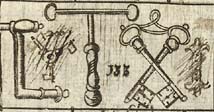 Image from proof plate
In the dexter side of this quarter are two Keys endorsed, the Bows held together with an Annulett. ... See numb.135.
Keys
 On the sinister side of this square, He beareth
two Keys in Salter.
On the sinister side of this square, He beareth
two Keys in Salter.
Related text(s)
Jack parts
Smith's forge
 CXXXIV. He beareth a Smith Forge,
and Trough, with a Fire on the
Hearth.
CXXXIV. He beareth a Smith Forge,
and Trough, with a Fire on the
Hearth.
Related text(s)
Forge parts
Forge equipment
Keys
 Image from proof plate
CXXXV. He beareth Gules two Keys endorsed
and conjoined in the Bowes.
 Previous section
 Next section
