
From the Smith and Farrier, we proceed to the Spurrier and Loriner or Bit-maker, whose Tools are the same, and therefore shall onely give some examples of what Works of theirs are born in Arms, and what Terms of Art they use about them.
Scotch spur
 Image from proof plate
XXXIV. He beareth a Scotch Spur. This is an old way of making Spurs, Rowels not then being in fashion, as may be seen in many ancient Seals of men on Horse-back, where their Spurs were only armed with a sharp point like a Cocks Spur, the Buckles being solidly fixed to the Heel-piece.
Spur
 XXXV. He beareth a Spur Leathered.
In the Spur there is these nominal parts.
The Rowel, the Neck, the Eye or Rivet hole,
and Rivet, the Shank, the Button holes, the Button and Hooks, and the Buckles; which are all so
well known that they need no farther description, but
the last named, hath several terms in it, which you
may see numb.37.
XXXV. He beareth a Spur Leathered.
In the Spur there is these nominal parts.
The Rowel, the Neck, the Eye or Rivet hole,
and Rivet, the Shank, the Button holes, the Button and Hooks, and the Buckles; which are all so
well known that they need no farther description, but
the last named, hath several terms in it, which you
may see numb.37.
Buckle
 XXXVI. He beareth a Buckle, with a
Spur Neck and Rowel fixed thereunto.
XXXVI. He beareth a Buckle, with a
Spur Neck and Rowel fixed thereunto.
Fermales
 XXXVII. With in this Quarter, and the two next
Succeeding, I do present you with nyne severall sorts of
Buckles, which I have found, and seen born in coats of
Armes.
XXXVII. With in this Quarter, and the two next
Succeeding, I do present you with nyne severall sorts of
Buckles, which I have found, and seen born in coats of
Armes.
The first is a Buckle or Fermale. Buckles are called Fermales or Fermaults, but more generally in the Plural Number Fermaulres.
Spur buckle
 The Second is termed a Spur Buckle, which hath
more to it than any other Buckle that is born in Arms
by those things called, a Chape, which holdeth the
Tongue of the Buckle in its proper place: And the
Cross Barr in the Diameter of it, to which they are
fixed.
The Second is termed a Spur Buckle, which hath
more to it than any other Buckle that is born in Arms
by those things called, a Chape, which holdeth the
Tongue of the Buckle in its proper place: And the
Cross Barr in the Diameter of it, to which they are
fixed.
If it be blazoned a Garter Buckle, the Chape hath a Button fixt on the end of it; and such Buckles are made on the Garter of Honour, as you may see chap.1. numb.88. and chap.2. numb.59. This Buckle is also made square.
Girth buckle
 The third is a Girth Buckle, or of some termed a
Square Buckle.
The third is a Girth Buckle, or of some termed a
Square Buckle.
Buckle
 The first in this Square is termed an
Halfe round Buckle, Some blazon it, a Semiron
(or Semi round) Fermale.
The first in this Square is termed an
Halfe round Buckle, Some blazon it, a Semiron
(or Semi round) Fermale.
Buckle
 The Second is termed, a Triangle Buckle, or a
Three square Buckle.
The Second is termed, a Triangle Buckle, or a
Three square Buckle.
Buckle
 The third is termed either a Losenge, or Mascle
Buckle, or Fermale (or Fermaile, as some write it).
The third is termed either a Losenge, or Mascle
Buckle, or Fermale (or Fermaile, as some write it).
Buckles
 He beareth in the first place, a Fermale or
Buckle, the Tongue pendant.
The second is termed a Buckle garnished and
studded. Now of these sorts of adorning Buckles,
take notice that Garnishing is to have them chafed or
wrought over with Flowers, Branches, Leaves, and such
kind of work: But Studding is to have them plain
wrought up, and set with spots resembling Stones or
Button heads.
He beareth in the first place, a Fermale or
Buckle, the Tongue pendant.
The second is termed a Buckle garnished and
studded. Now of these sorts of adorning Buckles,
take notice that Garnishing is to have them chafed or
wrought over with Flowers, Branches, Leaves, and such
kind of work: But Studding is to have them plain
wrought up, and set with spots resembling Stones or
Button heads.
The third is a square Fermale, Buttoned at each corner, the Tongue Bendwise. In this Buckle we must suppose the Tongue is slipt out of its place, for want of a Chape; for a Buckle of this form is looked upon to be very useless, if the supposition aforesaid be not granted.
Spur rowel
 XL. He beareth a Spur Rowel of eight
points.
XL. He beareth a Spur Rowel of eight
points.
Rowels


 XLI. He beareth in this quarter 3 sorts of Rowels; the first is a Rowel of four points.
The second is a Spur Rowel, which some term a Mullet pierced. yet by reason the Rowel is ever born pierced, and the Mullet not, it were best and most proper to term them Mullets when not pierced; and Spur Rowels when pierced.
The third is a Rowel of three points, which some take to be a Galthrope, but such are mistaken in their Judgment, that being quite another thing.
Spur rowels
 Image from proof plate
XLII. He beareth a Spur Rowel of six points.
Spur rowel
 XLIII. The first is termed a Spur Rowel blemished or rebated.
Mullet
 The second bearing in this quarter, is termed a
Mullet.
Now the difference between a Mullet and a
Spur Rowel, I have shewed numb.41.
Again a Mullet cannot properly be a Rowel, by reason they want that finishing on
the sides, which the Rowel hath.
The second bearing in this quarter, is termed a
Mullet.
Now the difference between a Mullet and a
Spur Rowel, I have shewed numb.41.
Again a Mullet cannot properly be a Rowel, by reason they want that finishing on
the sides, which the Rowel hath.
Horse bit
 XLIV. He beareth an Horse Bit.
Some do call it a Bit or Snaffle, a Bridle Bit, or
an Half Cheek-Bit. Mr Morgan calls these Curbs
or Curb Bits.
XLIV. He beareth an Horse Bit.
Some do call it a Bit or Snaffle, a Bridle Bit, or
an Half Cheek-Bit. Mr Morgan calls these Curbs
or Curb Bits.
Related text(s) Horse bit types Horse bit parts
Snaffle
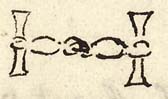 XLV. He beareth a Bit or Snaffle in Fess
between two Bosses.
XLV. He beareth a Bit or Snaffle in Fess
between two Bosses.
Bosses

 XLVI. He beareth three Bosses. The
Bosses of Bits are only an adornment to them, being for
no other use; and therefore in their round and swelling
form the Workman maketh what figures and devises he
pleaseth, as these with severall others of like nature will
witness the truth thereof.
XLVI. He beareth three Bosses. The
Bosses of Bits are only an adornment to them, being for
no other use; and therefore in their round and swelling
form the Workman maketh what figures and devises he
pleaseth, as these with severall others of like nature will
witness the truth thereof.
 Previous section
 Next section
