
Ball stock
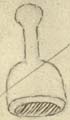 71 He beareth a Ball stock.
These are halfe round Balls turned
hollow within on the flatt side, and an
handle fitted into the outward round to
hold them by: they are filled either with
wool or Haire well carded or beaten,
and then couered with Leather vndressed; with these Balls the Inck is
taken off the Block and worked on them
by clapping them roundly one vpon the
other, so being well distributed on the
Ball it is from them dabbed or beaten
on the face of the form of letters.
71 He beareth a Ball stock.
These are halfe round Balls turned
hollow within on the flatt side, and an
handle fitted into the outward round to
hold them by: they are filled either with
wool or Haire well carded or beaten,
and then couered with Leather vndressed; with these Balls the Inck is
taken off the Block and worked on them
by clapping them roundly one vpon the
other, so being well distributed on the
Ball it is from them dabbed or beaten
on the face of the form of letters.
Plattin
 72. This is the forme or fashion of
the Plattin; whose office it is to press
the paper vpon the face of the letters,
that it may receiue the print of the
Black put or beaten vpon them. It
is a plank neer three Inches thick,
about 9 Inches broad and 14 long, the
face or vnder side is plained exactly
straight and smooth; neere the foure
corners on the vper side, it hath 4 Iron
Hooks, whose shanks are wormed in.
In the midle on the same side, is a
square Iron plate let in and fastned,
this is called the Plattin Plate; in the
midle whereof is a square Iron frame,
about halfe an Inch high, into which
is placed, the stud of the Plattin pan,
so as it may stand steddy, and yet be
taken out and put into the frame as
occasion may require. This stud is
widder at the top then the bottome,
whose top is called the Plattin Pan, in
the midle whereof is a small centre hole
punched, for the Toe of the spindle to
worke in.
72. This is the forme or fashion of
the Plattin; whose office it is to press
the paper vpon the face of the letters,
that it may receiue the print of the
Black put or beaten vpon them. It
is a plank neer three Inches thick,
about 9 Inches broad and 14 long, the
face or vnder side is plained exactly
straight and smooth; neere the foure
corners on the vper side, it hath 4 Iron
Hooks, whose shanks are wormed in.
In the midle on the same side, is a
square Iron plate let in and fastned,
this is called the Plattin Plate; in the
midle whereof is a square Iron frame,
about halfe an Inch high, into which
is placed, the stud of the Plattin pan,
so as it may stand steddy, and yet be
taken out and put into the frame as
occasion may require. This stud is
widder at the top then the bottome,
whose top is called the Plattin Pan, in
the midle whereof is a small centre hole
punched, for the Toe of the spindle to
worke in.
Side stick
 In the Base, vnder this Plattin, is
engraven the forme and fashion of one
of the Printers furniture for the locking
vp of their formes and is termed a side
stick: it goeth taper from one end to
the other, by which meanes it is with
short wedges, droven tight and straight
to the letter sides, that they cannot
drop out of the Iron Chase. The out
side sticks, and the foot sticks are
quadrat high and are cut to the iust
length and breadth of the perticuler
pages. Quoines are much shorter, and
haue on of their sides beviled away
to comply with the Bevile of the side
and foot sticks, whose office is to lock
vp the forme.
In the Base, vnder this Plattin, is
engraven the forme and fashion of one
of the Printers furniture for the locking
vp of their formes and is termed a side
stick: it goeth taper from one end to
the other, by which meanes it is with
short wedges, droven tight and straight
to the letter sides, that they cannot
drop out of the Iron Chase. The out
side sticks, and the foot sticks are
quadrat high and are cut to the iust
length and breadth of the perticuler
pages. Quoines are much shorter, and
haue on of their sides beviled away
to comply with the Bevile of the side
and foot sticks, whose office is to lock
vp the forme.
[Image identified as Foot stick by Moxon]
Shooting stick
No image located
A shooting stick, is Hard wood of the same forme, by which with the force of a Mallet, the form is so wedged, that it may be raised with the letters in.
Press carriage
 73. I haue in this figure presented
you with the exact fashion of the
carriage of a Printers presse, with its
coffin, and all other its appurtenances
constantly fixed to it. It consists of a
plank two Inches thick, 4 foot long,
and 1 foot 8 inches broad: at its further
end it is nailed firmely downe a square
frame, this is called a coffin and in it
is bedded the Marble ston, or Plank of
Lignum Vitae. At the foure corners
of the coffin are nailed down and let in
a square Iron plate, with return sides,
about 6 Inches long, whose inner angles
are obtuse, or sloped away from the
inner angle so as the Quoins or wedges
may doe their office between each inner
side and the chase.
73. I haue in this figure presented
you with the exact fashion of the
carriage of a Printers presse, with its
coffin, and all other its appurtenances
constantly fixed to it. It consists of a
plank two Inches thick, 4 foot long,
and 1 foot 8 inches broad: at its further
end it is nailed firmely downe a square
frame, this is called a coffin and in it
is bedded the Marble ston, or Plank of
Lignum Vitae. At the foure corners
of the coffin are nailed down and let in
a square Iron plate, with return sides,
about 6 Inches long, whose inner angles
are obtuse, or sloped away from the
inner angle so as the Quoins or wedges
may doe their office between each inner
side and the chase.
At the hinder end is two halfe Joynts, by which with an Iron pin the Tympan is ioyned to it, by 2 other Match halfe Joynts, fixed on the fram of the Tympan, which as on an Axis moves and keep the Tympan so truly gaged, that it alway falls down vpon the forme in the same place, and so keeps good Register.
On the hinder part of the plank of the carriage, is nailed down two female dovetaile Groves, into which is fitted two Male dovetailes made on the feete of the Gallows; on this the Tympan rests when it is raised of the Forme, so that by the sliding forwards or Backwards of these dovetaile feete, the height of the Tympan is raised or depressed according to the fancie of the Press man.
Behind the hinder Raile, or fram of the coffin is made a square hole of 4 Inches, on each side is placed a stud of wood with a round hole in the midle to receiue the ends of an Axis, on the square whereof is placed a round wooden Rowler or Barrell, with a shoulder on each side, to containe as much Girt as shalbe rowled on it; and to one end of the rowler is fastned an Iron circle or wheele, haueing the edges cut in teeth, so that it may stop against a clicker, when the rowler with an Iron pin is turned about to strain the Girt. At the other end of the coffin is the like wooden studs, Axis, Barrell, wheele, and clicker, the use of which two is one to draw the carriage vnder the Plattin, and the other to draw it back againe, vpon the turning of the Rounce.
Printers peel
 74. The Printers Peele. The use of
it is to hang papers on the Racks which
being hung ouer head, the printed paper
is layd on the edge of the peel and so
hung vpon the Railes: now the handle
of it may be longer or shorter according to the height or lowness of the
Roome that is convenient to dry paper
in.
74. The Printers Peele. The use of
it is to hang papers on the Racks which
being hung ouer head, the printed paper
is layd on the edge of the peel and so
hung vpon the Railes: now the handle
of it may be longer or shorter according to the height or lowness of the
Roome that is convenient to dry paper
in.
Head stick
No image located
75. This is a part of the printers Furniture, belonging to the well fixing or locking in of a forme of letters into the Iron chase, and is Termed an Head stick, which is made of dry seasoned wood, that it may not shrink when the form stands by, they are quadrat high and straight and of an equall thicknesse all the length.
Gutter sticks
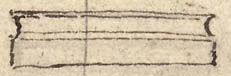 76. An other of their Furniture, is
Gutter sticks, or Inner side sticks, these
are also quadrat height, and are used to
be set between pages either in folios, or
either side the crosses as in 8. 12. 16.
and Formes vpwards they are of an
equall thicknesse their whole length,
like Head sticks; but they haue a
groove or Gutter in the vper side of
them, that they shall not print, when
through the tendernesse of the Tympan
the plattin presses it and the paper
lower then ordinary: And also that the
water may drain away when the forme
is washed and Rinced, the sticks are
usually made so broad as they will haue
the Margent to be.
76. An other of their Furniture, is
Gutter sticks, or Inner side sticks, these
are also quadrat height, and are used to
be set between pages either in folios, or
either side the crosses as in 8. 12. 16.
and Formes vpwards they are of an
equall thicknesse their whole length,
like Head sticks; but they haue a
groove or Gutter in the vper side of
them, that they shall not print, when
through the tendernesse of the Tympan
the plattin presses it and the paper
lower then ordinary: And also that the
water may drain away when the forme
is washed and Rinced, the sticks are
usually made so broad as they will haue
the Margent to be.
Composing stick
 77. The composing stick. It is to set
the letters letter by letter word by
word, and line by line in, they seldome
exceed the height as to containe 8 or 10
line especially if the lines be long,
Though it be termed a stick, yet it is all
made of Iron Plate about the thicknesse
of a scabberd and about 8 or 10 inches
long, and doubled vp to a square corner, at one end is sodered a head of
Iron so as to be true square; about 2 or
3 Inches from the head on the bottom
side is a row of round holes an Inch
assunder to receiue the shank of a male
screw that screws the sliding measures
fast to the Bottom, so that the sliding
measure may be set neerer or further
from the head as the measure of a page
may require. There are two sliding
measures the vpper and the lower, the
first being a little shorter then the other;
between those sliding measures Marginall notes are compassed to any widness.
77. The composing stick. It is to set
the letters letter by letter word by
word, and line by line in, they seldome
exceed the height as to containe 8 or 10
line especially if the lines be long,
Though it be termed a stick, yet it is all
made of Iron Plate about the thicknesse
of a scabberd and about 8 or 10 inches
long, and doubled vp to a square corner, at one end is sodered a head of
Iron so as to be true square; about 2 or
3 Inches from the head on the bottom
side is a row of round holes an Inch
assunder to receiue the shank of a male
screw that screws the sliding measures
fast to the Bottom, so that the sliding
measure may be set neerer or further
from the head as the measure of a page
may require. There are two sliding
measures the vpper and the lower, the
first being a little shorter then the other;
between those sliding measures Marginall notes are compassed to any widness.
Related text(s) Composing stick parts
Galley
 78. The Galley, is a thing to set and
compose pages in, and therefore they
are made of different sizes: It is made
all of Boards, that is two flat wanscot
Boards, about a quarter or less of an
Inch thick, the vppermost haueing an
handle, is to slide in Grooves made in
the frame fixed on the lower board, that
when a page is set and bound vp, it
may be drawn out of the Galley, and
from the slice quickly thrust of it vpon
the correcting ston.
78. The Galley, is a thing to set and
compose pages in, and therefore they
are made of different sizes: It is made
all of Boards, that is two flat wanscot
Boards, about a quarter or less of an
Inch thick, the vppermost haueing an
handle, is to slide in Grooves made in
the frame fixed on the lower board, that
when a page is set and bound vp, it
may be drawn out of the Galley, and
from the slice quickly thrust of it vpon
the correcting ston.
The Galley.
The Frame.
The Groove.
The Slice.
The Handle.
Chase
 79. The Chase is made all of Iron, or
an Iron Frame about 22 inches long,
and 18 broad, and quadrat high, and an
Inch in breadth, all its sides must stand
exactly square and flatt, equally bearing
on all sides and Angles when it lyeth on
the correcting stone. It hath two
Crosses belonging to it, a short cross and
a long cross, these haue at each end a
Male dustaile which are fitted into female dustailes filed in the inside of the
chase. The short cross hath in the two
midle parts of it a groove cut through
about a quarter of an Inch broad and 2
Inches or more long, for the point to
fall into them.
79. The Chase is made all of Iron, or
an Iron Frame about 22 inches long,
and 18 broad, and quadrat high, and an
Inch in breadth, all its sides must stand
exactly square and flatt, equally bearing
on all sides and Angles when it lyeth on
the correcting stone. It hath two
Crosses belonging to it, a short cross and
a long cross, these haue at each end a
Male dustaile which are fitted into female dustailes filed in the inside of the
chase. The short cross hath in the two
midle parts of it a groove cut through
about a quarter of an Inch broad and 2
Inches or more long, for the point to
fall into them.
The two crosses where they ly ouer one the other in the midle of the chase, are filed or notched halfe way through out on the vpper side, the other on the vnder side, to let into one an other. In these Iron chases are the formes of letter Locked vp, or wedged so titch that they are carried from place to place.
Printers racks
 80. These are the Racks on which
Printers hang paper on to dry after the
quires or sheets are printed off. They
are made of slitt dale Boards or Battens
rounded of on the top side, and square
below. These Racks are hung ouer
head either in the printing house, ware
house or both, or any other Roome
that is most convenient to dry papers in,
they are hung athwart the Railes a quire
thick, and are at distance about 10
Inches one from an other. The paper
is hung upon them by the help of the
Peele.
80. These are the Racks on which
Printers hang paper on to dry after the
quires or sheets are printed off. They
are made of slitt dale Boards or Battens
rounded of on the top side, and square
below. These Racks are hung ouer
head either in the printing house, ware
house or both, or any other Roome
that is most convenient to dry papers in,
they are hung athwart the Railes a quire
thick, and are at distance about 10
Inches one from an other. The paper
is hung upon them by the help of the
Peele.
Ribs
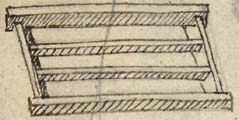 81. The Ribs of the press, are two in
number, and ly within a Frame, or
ioyned to two end railes all about two
Inches and halfe thick, but the side
railes stand higher, because the plank
of the carriage must slide betweene
them and be gaged by them, that it
joggle not on either side, but run steddy
and euen on the cramp Iron nailed on
the bottom of the carriage.
81. The Ribs of the press, are two in
number, and ly within a Frame, or
ioyned to two end railes all about two
Inches and halfe thick, but the side
railes stand higher, because the plank
of the carriage must slide betweene
them and be gaged by them, that it
joggle not on either side, but run steddy
and euen on the cramp Iron nailed on
the bottom of the carriage.
In the side Railes are framed the 2 end railes, and 2 Ribs at an equall distance from them, on which two Ribs are fast nailed down the Iron Ribs, for the cramp Irons to slide vpon.
Letter case
 82. This is the forme of the Letter
Case: a pair of cases is an vpper and a
Lower case: they are of an equall
length, breadth and depth: 2 feet
9 Inches long, and one foot 4 Inches
broad and about an Inch and quarter
deep: But for small bodied letters they
are made more shallower, and for great
bodied deeper. These cases are compassed about with a Frame an Inch
broad, with the like partition down the
midle of them, that the seuerall smaller
partitions may be lett into the substance
of the frame. But the vpper and lower
case partitions are not alike, for each
halfe of the whole length of the vper
case is diuided into seaven equall parts,
and its breadth into as many, that is
98 squares.
82. This is the forme of the Letter
Case: a pair of cases is an vpper and a
Lower case: they are of an equall
length, breadth and depth: 2 feet
9 Inches long, and one foot 4 Inches
broad and about an Inch and quarter
deep: But for small bodied letters they
are made more shallower, and for great
bodied deeper. These cases are compassed about with a Frame an Inch
broad, with the like partition down the
midle of them, that the seuerall smaller
partitions may be lett into the substance
of the frame. But the vpper and lower
case partitions are not alike, for each
halfe of the whole length of the vper
case is diuided into seaven equall parts,
and its breadth into as many, that is
98 squares.
But the two halfes of the length of the Lower case are diuided into 8 equall parts and the breadth into 7, yet this diuision is into foure seuerall sizes of Boxes: and the reason is, that the biggest Boxes may be disposed neerest the compositors hand, and to haue such letters as are most used in our English language, so that the Boxes as hold those sorts ought to be most capacious.
Related text(s) Letters, placing
Lye trough
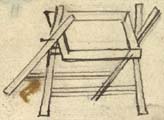 83. He beareth a Lye-trough,
Hung or peased on its Horse.
This is a square Trough made of
Inch boards, the inside couered with
lead, in the midle of the Two ends is
fastned a round Iron pin, which moues
in an hole made in an iron stud fastned in
wooden Horse or crosse barrs, with side
peeces mortised in them: the use of
this Trough is to wash the Forme of
letter when worked off, that noe Black
remaine on them to dry and furre the
face of the letter: and this is done by
rubing them ouer with a long Bristled
brush and Hott Lye, and by shaking and
turning the trough as it hangs on the
Woden horse by its pins.
83. He beareth a Lye-trough,
Hung or peased on its Horse.
This is a square Trough made of
Inch boards, the inside couered with
lead, in the midle of the Two ends is
fastned a round Iron pin, which moues
in an hole made in an iron stud fastned in
wooden Horse or crosse barrs, with side
peeces mortised in them: the use of
this Trough is to wash the Forme of
letter when worked off, that noe Black
remaine on them to dry and furre the
face of the letter: and this is done by
rubing them ouer with a long Bristled
brush and Hott Lye, and by shaking and
turning the trough as it hangs on the
Woden horse by its pins.
Lye kettle
No image located
84. He beareth on a Trevett, a Lye Kettle or chaffer, with Fagotts flamant. To performe the office of a Lye Kettle, which is to heat the Lye, Any pot, pan or skellett, may be made usefull, but generally for such a bussiness the old fashioned chaffer is most commodious, because they are more handy then Kettles with Bailes, and also because they keep the Lye longer hot.
 Previous section
 Next section
