
From Towers we shall now speak something of Walls, and Tops of Walls, and Ends of Houses, for such are often found to be born in coats of Arms; as the following examples manifest.
Two gable ends
 Image from published plate
LXXVII. Within this Square are the forms of two Gable Ends of Houses. That in chief is termed a Gable end, the Fractable wrought into a Foot Table, Bottle, Square and Top or Crown Bottle.
The second is termed, a Gable end (as the foresaid) only the Crown Bottle, is called an O-G turned off with two Scrowls, with a Finishing on the Top.
Related text(s) Gable end terms
Walls
 Image from published plate
LXXVIII. Within this Square are three Walls extended through the Escochion, each having a Door in the middle, with a Cap or rising in the wall over it, of contrary formes, therefore of different Blazon.
The first is a Wall with a Cap or Bead over the Door, of a Bottle, or circular form. Such Workmen call the rising of the Wall, the Cover of the Door.
The second is a Wall, whose Door Cap is termed a Pedement Head of two Kneelers, all such rising thus in a point, is by Workemen called a Pedement or Gable End.
The third is a Wall whose Door head Cap or Cover is called a Square, or a Cover of Wheelers and Kneelers.
Gable end
 Image from published plate
LXXIX. In this square is first in chief, a Wall, or rather a Gable end of a Masonry House (that is) the end of a Stone House Imbattelled on the top.
Walls and doors
 Image from published plate
LXXX. In this square are two other Walls, whose Door Caps are mounted in form of Grieces, or having a Battlement Imbattled and if it be of a trebble height above the corners of the walled, then termed Battled Imbattelled, with a Battlement upon, or trebble Imbattled, or mounted up with 2, 3 or 4 Grieces.
The second is a wall of a Castle, the Gates displaid or set open, the Portcullis drawn up to the top of the Port, capped or covered with one Battlement Imbattelled.
Steps with pyramid; Legionary eagle
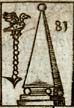 Image from published plate
Pillars
 Image from published plate
Square castle
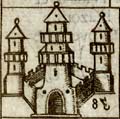 Image from published plate
Towers
 Image from published plate
Towers
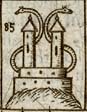 Image from published plate
Window; Church steeple
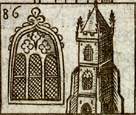 Image from published plate
LXXXVI. Here are two things in this Square pertaining to a Church or Temple. As first, He beareth a Window or Church Window.
Secondly, He beareth a Foure Square Steeple, each corner Supported with a Buttrice, the Top set off with Moulded Battlements, and the Corners with Carved Finishings or Pinicles, with a Spiral Roofe, ensigned with a Cross.
Related text(s) Window terms
China steeple
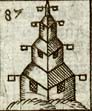 Image from published plate
LXXXVII. He heareth a China Steeple. All the steeples in that Countrey are made after this form, riseing one Story above an other, and each less than other, and this they do for many heights, which when they would shew Magnificence in their Buildings, they adorn the out sides and tops, with a multitude of Fanes or Square Banners.
Hexagon towers
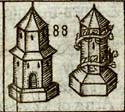 Image from published plate
Towers
 Image from published plate
Dove houses
 Image from published plate
XC. In this square is set down two sorts of Dove-houses. The first is termed an House or Cote set upon a square Pillar. This is an excellent way to secure Pigeons or Pultrey from destructive Vermine, being no way able to get into the same. Such a Building as this, a larg Barne of severall Bayes is set up neere the Citty of Chester upon stone pillars, into which neither Ratt or Mouse can gett; an though they may be brought in with the Sheaves out of the fields, yet they must out for water, and being out there is no returning againe to that quarters.
The Second is a Dove house of foure Cants, or Cornered Bayes, with a Louver on the Roof. This may likewise be termed, a Gentlemans house, or an Hall; A mansion, or Mannor house built in the form of a Cross, with a Lanthorne in the middle of the Roofe.
Round tower
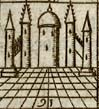 Image from published plate
Tower
 Image from published plate
Tower
 Image from published plate
Castle walls
 Image from published plate
Portcullis
 Image from published plate
Tower
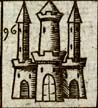 Image from published plate
Towers
 Image from published plate
Triumphant arch
 Image from published plate
Triumphant arch
 Image from published plate
Hermathena; Roman victory trophy
 Image from published plate
Pulpit
Image from published plateC.* He beareth a Pulpit with its Cover.
Trojans column
 Image from published plate
Thunderbolt; British flask; Portcullis reversed
 Image from published plate
CII. He beareth in chief a Thunderbolt, and in base the top of a British flask, and a Porculas reversed.
First, the Thunderboult after this form was born by Marcus Antonius...
The second is the top or head of a Brittish Flask, or Power Flask, this being the part by which the charge of the Gun is rightly made; the whole Flask you may see Chap. 18. numb. 60. Some term them the head of a Charging Flask.
The third is called a Portcullis reversed, with a round top: others term it the head of a Dart spear, such as they strike great Fish withal.
Candlestick
 Image from published plate
XIII. He beareth a Candle-stick of three Branches...
Portcullis
 Image from published plate
 Previous section
 Next section
