
4. Having now given you as large an account of the works of Masonry, with the several sorts of such bearings as I have found in Arms. It now remains, that in the remaining part of the Plate, I give you some Examples of bearing, which indeed cannot properly be mustered under any certain Head; having neither Head nor Tail but things of a confused confusion: many whereof I must plead Ignorant in, not knowing properly what term to give them, having only seen them in French, Dutch, German, Poland, Spanish, and Italian coats, with the bearers names, but not otherwise. Therefore I must term them Heterodites, or Extravegant things, that are under no rule, or order; but are rules to themselves.
Old fashioned trepan; Perch; Folding stool
 Image from published plate
CV. The first bearing in this quarter is termed an Old fashion Trepan, as I take it to be a Chirugions Instrument. See Chap 11. numb. 48. and this chap.numb. 122.
The second is called a Pearch; but the Latines name it Sella Curulis, which the Italians take to be the the Ivory Chair so often expressed in the Roman Medals and Coined pieces. See Chap. 20 numb. 50.
The third is termed a Foulding Stool, or Seat to set in. This may also be termed another of the Roman Ivory Chairs, which is oft found stamped on the Roman Medals of old.
Spurs; shur shanks
 Image from published plate
[First, two heel spurs; second and third, the shanks of two spurs conjoined; fourth a cramp iron in the form of a circle.]
Cramps
 Image from published plate
[First, an iron cramp in the form of a horseshoe; second, semicircle with the ends reversed; third, cramp in the form of a serpent]
Cramp iron; Annulets
 Image from published plate
Candle socket; Garlic head; Apple roaster
 Image from published plate
CIX. In this quarter are three other bearings, which when I know how better to term [them] you shall have it, in the main time rest satisfied, that the first is called a Candle socket, or a toole Socket, for a Candle-stick, or else the wide end of a Recorder or Hoboy
The second is ... representing a Garlick head ... Some term it a Chive, the head erected, or a Garlick head, the Leaves Reversed.
The third ... we may in English render a Rattle or a Childs toy to play with, or according to the latter, it is a Dwarfe Cherry tree: But how like it is to either, I leave to the Reader to judge. I shall rather take it for an Apple roaster, being maide of an Hay-thorn branch or Iron, with so many hooks, or forked ends, to stick into Apples and so to hang them before the fire to Roast.
Gringolee; Collarino
 Image from published plate
[Heraldic designs]
Barbed shaft; Rams horns; Chess Rook
 Image from published plate
... The third is called a Chess Rook, with a Cypress sprig in the hollow of it.
Hunter's horns; Cart wheel felloe with spoke; Crescent shield
 Image from published plate
Rook
 Image from published plate
CXIII. The first in this square is termed by the French a Roch or Rock, if for the Chess board.
Cooks golding iron
Image from published plateThe second is termed a Cooks Golding-Iron, it is made of Brass or Iron, by which they Cut and Carve their Past, for to adorn their Pyes and Pasties, with variaty of Leaves and Flowers.
Double hook iron
Image from published plateThe third I take to be a Double Hook Iron, or an Iron with a Hook at each end contrarey bowed; such as these are oft made use of to hang things on, and so to hang the opposite Hook on Pins or in Stables.
Raft
 CXIV. He beareth a Raft or Float.
Wall-stone; Mill-iron; Tile; Turner's mandril
 Image from published plate
CXV. In this quarter are four bearings resembling yet not like one another
The first is termed a Muersteen, that is a Wall Stone, for so the Dutch name it.
The second is a Mill-iron, which we term the Millrind , or Ink of a Mill.
The third is a square Tile, porforated, or thrust through the middle with a Brick Ax
The fourth is called a Turners Mandril, made after the old fashion; what it is, and for what use, I shall refer you to the Turners working Tools, chap. 8, numb 150, 151.
Nail; Staff; Pale; Pale pierced
 Image from published plate
[Heraldic designs]
Crow Stone; Triangle; Trepan; Old British A and R
 Image from published plate
CXVII. Here are also five sorts of bearings in this square which are as the Proverb saith of Gibbs Children of Leen, none like an other; yet all make Coats of Arms of like Honour.
[Heraldic designs]
Old alphabet letters; Vee with spur rowel
 Image from published plate
[Heraldic designs]
Lamp; Insula or copped cap; Dutch or triangle coulter
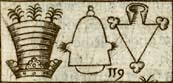 Image from published plate
[Heraldic designs]
 Previous section
 Next section
