
13. Some Instruments and Tools belonging to a Farrier, which before I was ignorant of, having now found out, I desire them to be added to chap.7. numb.25. as followeth.
Unclenching knife
 CXXXVI. In this square are three Farriers Instruments; the first is termed an unclenching Knife; this
loosens the points of the Nails which are clenched upon
the top of the Hoof to take the Shooe off, or to remove
it; the point is raise up the Nail if it be deep in the
Hoof.
CXXXVI. In this square are three Farriers Instruments; the first is termed an unclenching Knife; this
loosens the points of the Nails which are clenched upon
the top of the Hoof to take the Shooe off, or to remove
it; the point is raise up the Nail if it be deep in the
Hoof.
Paring hook
 The second is termed a paring Hook or Knife,
with this the Hoof is cut when it exceed the breadth of
the Shooe.
The second is termed a paring Hook or Knife,
with this the Hoof is cut when it exceed the breadth of
the Shooe.
Incision knife
 The third is termed a Knife, or Farriers incision
Knife; with it all sorts of Sores are Lanced and cut Open in all the parts of an Horse Body.
The third is termed a Knife, or Farriers incision
Knife; with it all sorts of Sores are Lanced and cut Open in all the parts of an Horse Body.
Case of fleams

 CXXXVII. This is termed a Case of Flames, all
laid open, in which there is six sorts of Instruments;
the two outmost which are hooked are termed Drawers; another is a Pen Knife; and another with a
sharp point, called a Lancer; and the two middlemost
are Flames, one sharp, the other broad pointed:
These are for several uses about Diseased Horses or Beasts,
as the Drawers are to scrape out Corruption in a Wound
or Bruise; the Knives and Lancers to make incisions,
and open Wounds and Bruises, and the Flames to let
Blood.
CXXXVII. This is termed a Case of Flames, all
laid open, in which there is six sorts of Instruments;
the two outmost which are hooked are termed Drawers; another is a Pen Knife; and another with a
sharp point, called a Lancer; and the two middlemost
are Flames, one sharp, the other broad pointed:
These are for several uses about Diseased Horses or Beasts,
as the Drawers are to scrape out Corruption in a Wound
or Bruise; the Knives and Lancers to make incisions,
and open Wounds and Bruises, and the Flames to let
Blood.
Buttrice
 CXXXVIII. In this square are three other sorts of
Farriers Instruments; the first is termed a Buttrice,
with this the sole of the Foot, and the Heel is pared
when it is overgrown, also the bottom of the Hoof, to
make the Shooe sit easie and streight on the foot.
CXXXVIII. In this square are three other sorts of
Farriers Instruments; the first is termed a Buttrice,
with this the sole of the Foot, and the Heel is pared
when it is overgrown, also the bottom of the Hoof, to
make the Shooe sit easie and streight on the foot.
Cauterising iron
 The second is termed a Cauting iron, or a Cautering Iron, or Searing iron; with it the parts
of an Horse whose Disease requires Burning, are feared
with it.
The second is termed a Cauting iron, or a Cautering Iron, or Searing iron; with it the parts
of an Horse whose Disease requires Burning, are feared
with it.
Blooding stick
 The third is termed a Blooding stick or Striker;
it is an heavy piece of Wood, wherewith the Fleme is
smitten or driven into the Horse Neck Vein, when he is
Blooded.
The third is termed a Blooding stick or Striker;
it is an heavy piece of Wood, wherewith the Fleme is
smitten or driven into the Horse Neck Vein, when he is
Blooded.
Patten shoe
 CXXXIX. These are four sorts of Shooes used for
infirm and Diseased Horses, which go Lamely or ill-favouredly.
CXXXIX. These are four sorts of Shooes used for
infirm and Diseased Horses, which go Lamely or ill-favouredly.
The first is termed a Patten Shooe; this hath both Caukins to secure fore Heels, and also a Shoulder before, to raise the foot from the ground.
False quarter shoe

 The second under it, is termed a false quarter
shooe, this hath one of the Heel Taps cut off, and is
for an Horse that hath a sore side Hoof.
The second under it, is termed a false quarter
shooe, this hath one of the Heel Taps cut off, and is
for an Horse that hath a sore side Hoof.
The third in the sinister chief, is termed also a false quarter shooe, with a shoulder in the side.
Lunet shoe
 The fourth under it, is called a Lunet shooe, having both ends cut off. This kind of Shooe is used to
Horses that have weak Heels.
The fourth under it, is called a Lunet shooe, having both ends cut off. This kind of Shooe is used to
Horses that have weak Heels.
Related text(s) Flat shoe Cross bar shoe
Cramp
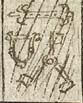 Image from proof plate
CXL. In the chief of this square, is another piece of Smiths work, which may be termed either a Cramp or Plate Flory at both ends, having holes therein in order to its fastning. These are generally Nailed from one piece of great Timber to another, to keep them from shrinking or leaving the place where set.
Escutchion buckle
Image from proof plateOn the dexter side of this square, is an Escochion Buckle, or rather an Orle like Fermale, having the Tongue turned to the Sinister and broke in two in the middle, the corners Bottony.
Key treble shanked

 ... Three Keys in Triangle fixed in the head to an Annulate or one Bow.
 Previous section
 Next section
