
The Ropemakers Instruments for making Ropes.
Ropers hook
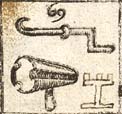 Image from proof plate
CLXIX. He beareth a Ropers Hook, and Top: by the first is the Rope Yarn Spun, or turned in the Slead, when it is Laid for the making of a Cable; and is generally termed a Slead Hook. The second called a Ropers Top, is a round piece of Wood taper wise, with three half round Gutters in the out sides, with an handle to hold and guide it; through these Gutters the Ropes run as they are Sarved or Pleated into a Cable. These are made of several sizes or bigness, according to the largeness of the Quoil, or thickness or the Rope or Cable made.
Ropers stake
Image from proof plateIn the Sinister base is another Instrument of the Ropers, called a Ropers Stake, only of three Tangs, or Teeth to keep the Fakes or Rope Yarn in Spinning, that they neither touch or tangle one with another, when two, three, or four are working together, and set in a Basis, or over Thwart piece to keep it upright.
Ropemakers winch
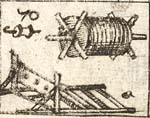 Image from proof plate
CLXX. He beareth a Ropemakers Wince or Winch: when the Spinner hath drawn out his Rope Yarn to that considerable length he can, then it is taken from the Wheel Spindle, and Wound upon the Wince till it be as full as the cross staves will contain it. It is turned upon an Iron Bolt fixed in the Wall or the like, when it is full it is called a Wince of Yarn.
Ropers slead
Image from proof plateThat marked (a.) in the Base is termed a Ropers Slead, a thing by which they Twist their Ropes, it is termed more properly the Laying of a Rope, when they make double, treble, or fourfold Cable Ropes: It hath these several parts.
Standards,
Plank,
Slot, to lay the weight on.
Ropers wheel spindle
Image from proof plateThat in the Dexter chief is blazoned a Ropers Whare or Wharve, or Wheele Spindle, and is one of those little hooks, with a Spindle on its Shank, that turns or spinns the Hemp into Rope Yarn by the help of a Leather compassing the great Wheele and the Spindles.
Turning braid
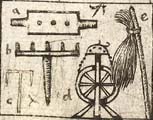 Image from proof plate
CLXXI. In this Quarter are four Instruments very much used by the Roper. The first in the Dexter chief is termed a Turning Braid, marked (a.) it is only a piece of Wood cut with handles having three holes in which are put the handles of the hooks, that Ropes are turned, where being well seated in the said holes by the help of this Engine in moving it up and down, too and again, one Person will with ease turn all the three hooks with long Ropes fixed upon the ends of them, which other wise would require two or three Persons to turn.
Ropers stake
Image from proof plateThe next under it marked (b.) is termed a Ropers Stake, this is a Stay or Stake with many Teeth or divisions of its use, see before numb.169.
Neptunes mace
Image from proof plateThat in the dexter base marked c is termed a Neptunes Mace
Ropers wheel
Image from proof plateThe third is the Ropers Wheele, marked (d.) by which the Rope Yarn is made or Spun: this Wheele is turned between two standards with an Head-stock on the top, wherein by the help of a Wheele-string or Band, is turned one, two, three or more Whares with hook:
It hath several parts.
Frame,
Wheele Stocks,
Head of the Stocks, where the Spindle runs.
There is another way of fixing the Wheel between four Standards with Cross Pieces in the middle, after the form of two Roman H's, through the middle of which pieces turns the ends of the Axle-Tree, or Spindle, by which the Wheele is turned, having a Semi-circle Board on the top of either Standard (as the former Wheele) between which is turned two, three or four Wharles or Whares, with hooks at the ends of their Axles to Twist and Spin the Rope Yarn; being turned by means of a Wheele-string or Leather compassing them and the Wheele.
Distaff
Image from proof plateThe last, is that on the Sinister side marked (e.) termed a Distaff, or a Distaff full of Hemp, from this the Spinner by going backwards draws the Hemp which the Whares turn into Yarn.
Related text(s) Nippers
 Previous section
 Next section
