
Section III.
Pin-Makers Tooles.
From the Press we proceed to the Pin, where let vs take a view of what Instruments or Tooles are Born or fit to be born in Coats of Armes in or belonging to the Trade of Pin makeing.
Pinners cutters
No image located
106. He beareth a Pinners Cutters. Of this se more in numb 110.
Drawing bench

 107. This is termed a Drawing Bench
on which by the help of those engins
and Instruments fixed vpon it, the Pin
maker draws forth his thick brass wyer
to what smalness he pleaseth and for the
making of all sorts and sizes of Pins.
107. This is termed a Drawing Bench
on which by the help of those engins
and Instruments fixed vpon it, the Pin
maker draws forth his thick brass wyer
to what smalness he pleaseth and for the
making of all sorts and sizes of Pins.
The first thing that is set on it is a Rice, it is set on an Iron rod or staff of wood vpon which it turns.
The next fixed on the midle of the Bench is the drawing Iron, which is set against two strong Iron pins that it small not be moved from the place where it is set. In it there are holes all along, one bigger then an other according as he will haue the wyer drawn to a fineness.
The third is set at the other end of the Bench and is called a Winstil. It is a Great Wood Barrell, like the winding Barrell of a Jack, set on a strong Iron Axis, with a winch or Iron [cranke?] with a wood handle to turn it. Upon this Barrell the wyer is turned as it is drawn of the Rice through the seuerall degrees of holes made in the strong plate of Iron, and this is termed Wyer drawing.
Pinners hammer
 108. He beareth a Pinners
Hammer.
108. He beareth a Pinners
Hammer.
This is different from most trads mens Hammers, being a thick short head, with a smooth face at both ends with a thick short Handle.
Drawing tongs
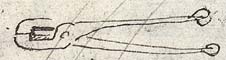 109. He beareth a paire of
drawing Tongues.
109. He beareth a paire of
drawing Tongues.
These are larger and broader and stronger in the chopps then a smiths Tongues else they much resemble theirs, but these haue an hollowing or open from the Revitt, like Pincers.
Pinmakers cutters
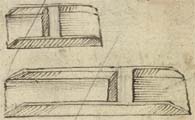 110. He beareth a pinmakers
.... cutters.
110. He beareth a pinmakers
.... cutters.
They are termed diuersely according to the length of the Pin they are to make, haueing one end from the midle partition longer by a degree then the other, for in the Hollow or trough they put seuerall wyers euen in the points altogether, and then with their cutting sheares cut them all off at one snap the length the Pin is to be.
Heading shears
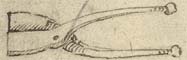 111. He beareth a paire of
Heading Sheares.
111. He beareth a paire of
Heading Sheares.
These are like to other larg cutting Sheares with Iron stailes and ends Buttoned, saue that they haue noe points, but are as if they were cut off in the midle of the Blades.
Pointing mile
 112. This is termed, The Pointing
Mile, this doth consist of two parts, the
Wheele and the Bench with its appurtenances fixed vpon it.
112. This is termed, The Pointing
Mile, this doth consist of two parts, the
Wheele and the Bench with its appurtenances fixed vpon it.
The Wheele is a large compass, with a Rim like a spinning wheele; for a long cord or small rope to turn vpon it, by which it turns a Pullay fix on a Iron Axell tree at a distance from it. This wheele is set between 2 strong wooden standards supported with Laces at the foote, haueing an Iron Axis and a Winch or crooked handle all of a peece, by which it is turned.
The Bench is made of a strong plank, and 4 short thick feet vnder it. Neere the ends aboue, is fixed two strong standards, each haueing a hole neere the top lined with Iron Bushes or Hoops, in which is put a long strong Iron Axell Tree, on which is fixed neere the midle, a Round large steele Barrell, all cut smooth like a smooth file, and a Pullay of wood fixed by it, by which it is turned by a Rope from the wheele; on this Barrell (by turning about) are the pins points ground sharp.
Drawing iron
No image located
113. This is the form of the drawing Iron, through which large wyer is drawn (as aforesaid) from hole to hole tell they draw it as fine as an heare.
Pinners heading wheel
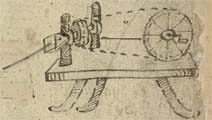 114. he beareth a Pinners
Heading wheele.
114. he beareth a Pinners
Heading wheele.
This wheele consists of these parts; it hath a kind of spining wheele set between standards, from whence goeth a string to a warve or small pulla, which turns the Axis, and it the long wyer on which the heads are turned.
Wheel heading
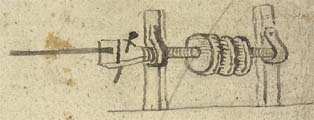 115. By this figure you may se more
perfectly the Heading part of the
wheele aforesaid, this being he principall concerne in it, which is thus set
forth by its seuerall parts.
115. By this figure you may se more
perfectly the Heading part of the
wheele aforesaid, this being he principall concerne in it, which is thus set
forth by its seuerall parts.
The two Standards fixed on one end of the wheele Block.
The Leather Socketts fixt on the stands through which the Axis went and turned.
The Iron Spindle or Axell tree, haueing a square head, with an hole made in the face, and an other to answer it made throw the side.
The Warve or small pullas, set in the midle of the Axis, haueing 2 or 3 notches or nicks in for the wheele string to turn.
The long straight wyer set in the square face to the Axell tree, on which the small wyer for pine heads is turned (just as Gimp is) all the length of it and then sliped off and cut into heads.
The Pin with an Head on, that holds the long wyer in the head, by being thrust through a hole made in the end of it, as the things themselues will better manifest.
Papering bar
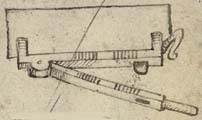 116. This is termed by the Pinner, a
Papering Barr, or Papering Barrs. It
is made all of Iron, with a ioynt to turn
vpon after the maner of a Joyners Rule,
with a male notch to enter into a female,
to hold it the more sure and steady,
with an hooke also to clap ouer the
handle, when it is closed to hold it
firme. In this is held the sheets of
paper folded, while the Pins in their
Roes (by the help of the nicks on the
top of the engine to direct) are thrust
in. This is usually for the better ease
to work at it fixed to the edge of a
Form or Table.
116. This is termed by the Pinner, a
Papering Barr, or Papering Barrs. It
is made all of Iron, with a ioynt to turn
vpon after the maner of a Joyners Rule,
with a male notch to enter into a female,
to hold it the more sure and steady,
with an hooke also to clap ouer the
handle, when it is closed to hold it
firme. In this is held the sheets of
paper folded, while the Pins in their
Roes (by the help of the nicks on the
top of the engine to direct) are thrust
in. This is usually for the better ease
to work at it fixed to the edge of a
Form or Table.
Pinners straight board
 117. He beareth a Pinners
Straight Board [with] the Pins.
By the help of this Board and strong
wyers set in an angle vpon it, wyer
drawn between them, being cross or
interturned by each standing Wyer.
doth immediately make it ly straight,
let it be neuer so long; neither will it
haue the least shew of a turn or bending
in it.
117. He beareth a Pinners
Straight Board [with] the Pins.
By the help of this Board and strong
wyers set in an angle vpon it, wyer
drawn between them, being cross or
interturned by each standing Wyer.
doth immediately make it ly straight,
let it be neuer so long; neither will it
haue the least shew of a turn or bending
in it.
Pinmakers stamps
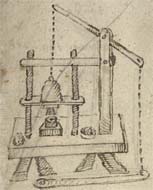 118. He beareth the Pin
makers Stamps. This is the
engine by which the heads of pins are
made fast vpon the shank of it, which
is done at a Blow, by raising with the
foot, an Iron weight and lett it fall on
the pin head laid on a small Stiddy or
Stake ..... as the figure of the thing
it selfe will more lively expresse the
maner of its operation, especially being
described by its seuerall parts.
118. He beareth the Pin
makers Stamps. This is the
engine by which the heads of pins are
made fast vpon the shank of it, which
is done at a Blow, by raising with the
foot, an Iron weight and lett it fall on
the pin head laid on a small Stiddy or
Stake ..... as the figure of the thing
it selfe will more lively expresse the
maner of its operation, especially being
described by its seuerall parts.
The Table or Tressell, is a thick plank set on four short strong Feet.
The Frame, is three vpright peeces or standards set all in a row, the length almost of the table, with a cross peece Mortised into them at the top, save the out side stand on the right hand is higher by some Inches then the other two.
The Ballance peece, is a Board fixed in the midle of the two short stands, in the midle whereof is a round hole. This keeps the hamer in its due place.
The Hammer is a round peece of Iron like the face of an hammer, which is set in a long round peece of Lead to make it weighty.
The Small Stiddy set in a square Box fixed in the midle of the table directly vnder the Leaded Hammer. Some call it a stak or small Anvile set on the work bench.
The Dishes at each end of the table one for the pin heads, the other for the pins when headed, the shanks of the pin lying in the Workmans apron.
The Tradle and String, is that as lieth under the table, which being trod down moves up the Sweep.
The Sweep and String, is the moveing beame or ...... which hanging by the midle or thereabout, on a pin in the slit or notche of the tall standard, so that drawing the end down, by the tradle; the other end riseth, and with it string draws vp the Leaded Hammer, halfe through the midle Ballance, and then falls directly on it place vpon a pin head, so fastens it on the pin shank.
Cutting shears
 119. He beareth a Paire of
Cutting or Shank sheares: fixed
vpon a strong Bench of Tressell.
119. He beareth a Paire of
Cutting or Shank sheares: fixed
vpon a strong Bench of Tressell.
This is such Sheares and so placed that a man may lay the strength of his feet to cause it to cutt as well as by strength of Armes. For the sheares are by a crooked return from the vnderside handle, is made fast in an hole in the Bench: and the vper handle hath a rope or chaine from the end of it through an hole in the Bench to a Tradle vnder it, by the help whereof they can cutt through many wyers together at one slap of the sheares. At one corner of the Bench is placed a Dish wherein the pin shanks are put, as the workman cutts them from of Wyer.
Pins
No image located
120. This doth present you with the maner and form of their puting of pins into Roes and Sheets, of which there are seuerall sorts which haue names according to their sizes and bignesses.
 Previous section
 Next section
