
10. Glass wrought by the Glasier, doth not so much benefit an House by Light, as with that Light, freeing the place, with its in-dweller, from Stormy Winds and Rain; Therefore as the benefit is double, so let us Praise the God of Lights, that we enjoy not only Light, but live in Safety in it; I mean the Gospel of the Word of Light.
Laperkin
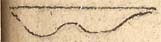 XCVIII. In this square are three Glaziers Tools;
the first is in chief, which is termed a Laperkin.
It is a short piece of Wood made streight on one edge,
but the contrary side endented, or rounded, or how
the Workman pleaseth for an adornment: With this,
being a kind of Ruler, he cuts Quarries or any Size,
and how he will, to fit them for the place he intends
to set the same.
XCVIII. In this square are three Glaziers Tools;
the first is in chief, which is termed a Laperkin.
It is a short piece of Wood made streight on one edge,
but the contrary side endented, or rounded, or how
the Workman pleaseth for an adornment: With this,
being a kind of Ruler, he cuts Quarries or any Size,
and how he will, to fit them for the place he intends
to set the same.
Soddering iron
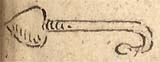 The second is a Soddering Iron, by which the
Leaden Joints on a Pane of Glass are Soddered together. In Soddering, there is used a Tile-Stone, or
any such thing a little hollow, having a little Rosin on,
upon which the Soddering Iron is often rubbed, to make
it take up the Sodder on the point of it.
The second is a Soddering Iron, by which the
Leaden Joints on a Pane of Glass are Soddered together. In Soddering, there is used a Tile-Stone, or
any such thing a little hollow, having a little Rosin on,
upon which the Soddering Iron is often rubbed, to make
it take up the Sodder on the point of it.
Glazier's chissel
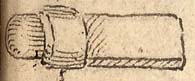 The third in the Base, is termed a Glaziers Chissel,
or a Working Knife; it is a piece of a Knife ground
round at the end, and set in an haft short and strong,
with an heavy Leaden Hoop about it; with the Blade
the Turned Lead is cut off to its length in the setting
of the Glass in the Lead; and also by the weight of
the Leaden handle, Nails are driven into the bench, to
keep it in, till it be Soddered; also with it old Lead is
opened, to take out broken Quarries, and put in whole
ones, from which employ it is termed a Stopping Knife.
The third in the Base, is termed a Glaziers Chissel,
or a Working Knife; it is a piece of a Knife ground
round at the end, and set in an haft short and strong,
with an heavy Leaden Hoop about it; with the Blade
the Turned Lead is cut off to its length in the setting
of the Glass in the Lead; and also by the weight of
the Leaden handle, Nails are driven into the bench, to
keep it in, till it be Soddered; also with it old Lead is
opened, to take out broken Quarries, and put in whole
ones, from which employ it is termed a Stopping Knife.
Glazier's moulds
 XCIX. In this quarter is the Glasiers Moulds;
they are made of Iron with long Riggets in, for the
casting of the Leads for to be drawn out by the Vice;
the Leads thus cast in these Moulds are termed Caums.
XCIX. In this quarter is the Glasiers Moulds;
they are made of Iron with long Riggets in, for the
casting of the Leads for to be drawn out by the Vice;
the Leads thus cast in these Moulds are termed Caums.
Working or stopping knife
 Image from proof plate
In the partition score between this and the next square, is placed an Instrument used by the Glasiers, being a Working or Stopping Knife at one end, and a Nipper at the other, and it is termed a Knife, and Grosing Iron conjoined in one. See numb.105.
Glazier's clamps
 C. In this quarter is the Glasiers Clams, or Holdfasts. It is a square bended
Iron, set in a strong hooped Handle, by help whereof it is held and made to
squeese the two sides of the Moulds close together, that
no Lead run out of the sides.
C. In this quarter is the Glasiers Clams, or Holdfasts. It is a square bended
Iron, set in a strong hooped Handle, by help whereof it is held and made to
squeese the two sides of the Moulds close together, that
no Lead run out of the sides.
Rosin box
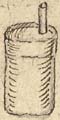 The second is the Rosin Box; it is a long Wooden Box with a hole in the cover, wherein is a Quill
set. It is filled with Pulverised Rosin, which is Knocked out of the Box through the Quill upon the Joints
in a Pane of Glass when they are to be Soddered.
The second is the Rosin Box; it is a long Wooden Box with a hole in the cover, wherein is a Quill
set. It is filled with Pulverised Rosin, which is Knocked out of the Box through the Quill upon the Joints
in a Pane of Glass when they are to be Soddered.
Quarry mould
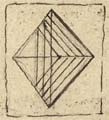 CI. In this part of the Plate, is the form of a Quarry Mould; it is a Blew Slate, whereon are drawn the
several sorts or sizes of Quarries of Glass, either Diamond Quarries or Pointed Quarries, with their
direct halves; the Sizes of their Quarries are from
Eighteens to Tens; Eighteens being the least sort of
Quarries, and Twelves and Tens the largest sort of
Quarries.
CI. In this part of the Plate, is the form of a Quarry Mould; it is a Blew Slate, whereon are drawn the
several sorts or sizes of Quarries of Glass, either Diamond Quarries or Pointed Quarries, with their
direct halves; the Sizes of their Quarries are from
Eighteens to Tens; Eighteens being the least sort of
Quarries, and Twelves and Tens the largest sort of
Quarries.
Cleaving board
 CII. In this square, is that thing which the Glasiers
call their Cleaving Board; it is a streight smooth
Board, where 3 or 4 pieces of Iron are set up an edge,
near the Verge of the Board on one side; at each
end is a square Iron with a Screw through it,
which runs too and fro in an Iron Rigget, which being set at their distances (according as the breadth of
the Squares or Quarries are to be cut out of the Table
of Glass) are Screwed fast that they cannot be moved;
and so the Screw shanks are a guide to keep the Ruler
to his due breadth of the Glass.
CII. In this square, is that thing which the Glasiers
call their Cleaving Board; it is a streight smooth
Board, where 3 or 4 pieces of Iron are set up an edge,
near the Verge of the Board on one side; at each
end is a square Iron with a Screw through it,
which runs too and fro in an Iron Rigget, which being set at their distances (according as the breadth of
the Squares or Quarries are to be cut out of the Table
of Glass) are Screwed fast that they cannot be moved;
and so the Screw shanks are a guide to keep the Ruler
to his due breadth of the Glass.
Glazier's diamond
 CIII. In the chief of this quarter is the Glasiers
Diamond; it is that by which he cuts his Glass, both
out of the Tables into Lengths or Clifts, and from
such long pieces or Clifts, into shorter pieces, as
Squares or Quarryes; or otherwise, according to
the form of his work.
CIII. In the chief of this quarter is the Glasiers
Diamond; it is that by which he cuts his Glass, both
out of the Tables into Lengths or Clifts, and from
such long pieces or Clifts, into shorter pieces, as
Squares or Quarryes; or otherwise, according to
the form of his work.
Planing board
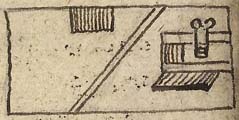 In and joined to the Base is another Cutting
Board, used by the Glasier, which he terms a Planeing Board, or a Cutting
Board: On this Glass according to its largeness, is cut into several forms, as
Square, or Quarry, or Fret-work, &c. It is a flat Board
with a long square piece of Iron in two Riggets to move
up and down, further and nearer, and to be fastned with
a Screw (as in the other Board).
In and joined to the Base is another Cutting
Board, used by the Glasier, which he terms a Planeing Board, or a Cutting
Board: On this Glass according to its largeness, is cut into several forms, as
Square, or Quarry, or Fret-work, &c. It is a flat Board
with a long square piece of Iron in two Riggets to move
up and down, further and nearer, and to be fastned with
a Screw (as in the other Board).
Vice handle
 CIV. In this square are the two Engines by which the
Glasiers Vice is set on work, the first on the Dexter side
is the Handle of the Vice, which turns it about when
it draws the Lead. It hath these terms in it.
CIV. In this square are the two Engines by which the
Glasiers Vice is set on work, the first on the Dexter side
is the Handle of the Vice, which turns it about when
it draws the Lead. It hath these terms in it.
The Eye.
The Shank.
The Handle.
The Rivett and Iron at the end of the handle.
Vice key
 The second, is the Vice Key; it hath an eye 6 or
8 square, by which with the help of its Handle, are
screwed on all the Nuts upon the Spindle ends,
which keeps the Case altogether.
The second, is the Vice Key; it hath an eye 6 or
8 square, by which with the help of its Handle, are
screwed on all the Nuts upon the Spindle ends,
which keeps the Case altogether.
Glazier's vice

 CV. In this quarter is the Glasiers Vice. It is made
all of Iron work, and covered with a Case of the
same; so that it cannot be set forth by any draught:
however I shall give you the Terms of all its parts and
members as workmen say.
CV. In this quarter is the Glasiers Vice. It is made
all of Iron work, and covered with a Case of the
same; so that it cannot be set forth by any draught:
however I shall give you the Terms of all its parts and
members as workmen say.
The Case.
The Coggs, of which there are two.
The Wheeles.
The Spindles.
The Cheeks.
The Stayes, the Irons that hold the Vice to the Board.
The Vice Board.
The Nuts, are those that screw on the ends of the Spindles to hold the Case fast together.
Simoning brush
 The Second thing in this quarter is the Oyle, or Simoning Brush. By the helpe of this Brush, the Leading
of the glasse is not only oyled and Simoned to keep out
foule weather, but old glass new leaded is clensed and
purifyed from filth, but made bright as if it were new:
This way of clensing old glass quaries, is of some Glassiers
termed Rubbers.
The Second thing in this quarter is the Oyle, or Simoning Brush. By the helpe of this Brush, the Leading
of the glasse is not only oyled and Simoned to keep out
foule weather, but old glass new leaded is clensed and
purifyed from filth, but made bright as if it were new:
This way of clensing old glass quaries, is of some Glassiers
termed Rubbers.
Devise of curiosity
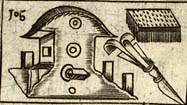 Image from published plate
In the sinister base of this square is the forme of a Double Grosier, and a Stoping knife all in one peece, a devise of curiosity, but for much imply a meer Drough: for he that worketh hard with it one day, will cast it aside next. Such an other-like toole you have engraven on the partition score betw: numb.99 & 100.
Quarry work etc

 CVI. In this square are set forth the severall ways that
of old Glassiers worked, or Leaded their glass Panes,
whither great or smal, which they termed as followeth.
CVI. In this square are set forth the severall ways that
of old Glassiers worked, or Leaded their glass Panes,
whither great or smal, which they termed as followeth.
1. Quarie Worke.
2. Square Worke.
3. Frett Worke.
4. Prospective worke.
[Second image from proof plate]
Pane work
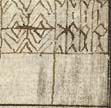 Image from proof plate
CVII. In this square are foure other sorts of Pane Work to which they gave these denominations.
1. Dimon, or Loseing Worke.
2.
3.
4.
Related text(s) Glazier's terms of Art
 Previous section
 Next section
