
Lapidaryes and Jewellers Instruments. 8. In this Section I shall present you with such tools and Instruments I find usually used by Stone or Jewl Cutters, called Lapidaryes and Jewel Workers, or makers up of Stones into Rings, Lockets, Jewels, and such like, which Trade is termed a Jeweller.
Corn tongs
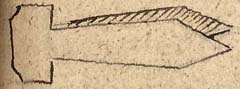 LXXXIII. In this quarter is four things useful in Jewelling, the first and that in chief is termed the Corn
Tongs.
LXXXIII. In this quarter is four things useful in Jewelling, the first and that in chief is termed the Corn
Tongs.
Enamel grinder
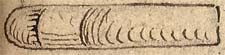 The second is the Inamel Grinder, or the Inamel
Pestel, or Enamel Muller, it bears those names,
and is no other thing than an Agate Stone set in a Brass
hoop or socket with a wooden handle; it is to Grind all
sorts of Inamels in a Flint Mortar, there being no
other and safer way to grind it.
The second is the Inamel Grinder, or the Inamel
Pestel, or Enamel Muller, it bears those names,
and is no other thing than an Agate Stone set in a Brass
hoop or socket with a wooden handle; it is to Grind all
sorts of Inamels in a Flint Mortar, there being no
other and safer way to grind it.
Flint mortar
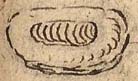 The third is a Flint Mortar; it is a piece of Flint
about the bigness of an ordinary apple, having a round
hole cut in it, and polished, in it Inamel is ground.
The third is a Flint Mortar; it is a piece of Flint
about the bigness of an ordinary apple, having a round
hole cut in it, and polished, in it Inamel is ground.
Boiling pan
 The fourth is a Boiling Pan.
Setting hammer
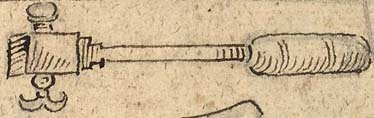 LXXXIV. Also in this quarter are likewise four other
sorts of Tools used by Jewellers. The first lying in chief
is a Setting Hammer.
LXXXIV. Also in this quarter are likewise four other
sorts of Tools used by Jewellers. The first lying in chief
is a Setting Hammer.
Wax stick
 The second in the Fess part, is termed a Wax Stick.
Muffler
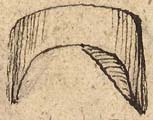 The third in the Dexter Base, is called a Mufler.
It is a long square piece of Coper Plate turned direct
half round, standing like an arch.
The third in the Dexter Base, is called a Mufler.
It is a long square piece of Coper Plate turned direct
half round, standing like an arch.
Wax box
 The fourth is a Wax Box, with a seven Stone
Ring set in it.
The fourth is a Wax Box, with a seven Stone
Ring set in it.
Using stone
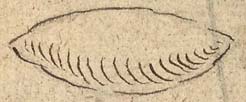 In this is first, the Using Stone; it is
a flat smooth Stone shooting out into two angles or points
on each side.
In this is first, the Using Stone; it is
a flat smooth Stone shooting out into two angles or points
on each side.
Enamelling bridge
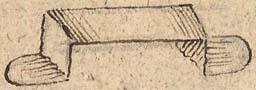 The second is the Inamelling Bridge; it is a long
piece of Copper about an Inch or more broad, and three
or more on the top, having the ends bent down into a
perfect square, and then bent out again for its more steady standing.
The second is the Inamelling Bridge; it is a long
piece of Copper about an Inch or more broad, and three
or more on the top, having the ends bent down into a
perfect square, and then bent out again for its more steady standing.
Enamelling tongs
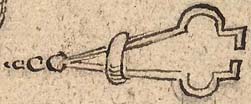
 The third is, the Inamelling Tongs.
Enamelling point
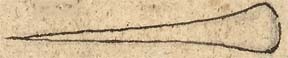 LXXXVI. In this quarter are three Instruments in
Base, and one occupying the room of the chief, which
I shall first name, and by the Artist termed an Enamelling point; It is for the
ordering and setling Ammell (when ground) in its place, upon the Ring to be
Enammelled.
LXXXVI. In this quarter are three Instruments in
Base, and one occupying the room of the chief, which
I shall first name, and by the Artist termed an Enamelling point; It is for the
ordering and setling Ammell (when ground) in its place, upon the Ring to be
Enammelled.
Simmon stick
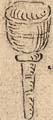 The first in the base is termed a Simmon Stick;
it is an handle with a round head, turned flat, yet hollow inwards, which hath a certain Simond clapt upon
it, or into it; in the same a Signet Ring is put, or on it
a Plate is fixed, while any thing is to be Engraven on
the same; it being not to be held any other way.
The first in the base is termed a Simmon Stick;
it is an handle with a round head, turned flat, yet hollow inwards, which hath a certain Simond clapt upon
it, or into it; in the same a Signet Ring is put, or on it
a Plate is fixed, while any thing is to be Engraven on
the same; it being not to be held any other way.
Bristle brush
 The second in the Base is a Brush, or a Bristle
Brush. such as Old Men formerly were wont to Brush
their Beards with.
The second in the Base is a Brush, or a Bristle
Brush. such as Old Men formerly were wont to Brush
their Beards with.
Hook wire
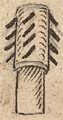 The third in Base is termed the Hockt Wyer; of
some the Hook Wyer.
The third in Base is termed the Hockt Wyer; of
some the Hook Wyer.
Lapidary's polishing mill
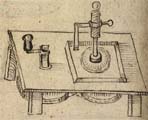
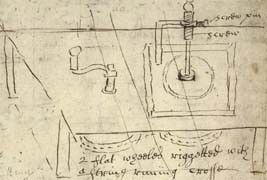 LXXXVII. In this square is a certain Engine or Mill,
called the Lapydaryes Polishing Mill.
LXXXVII. In this square is a certain Engine or Mill,
called the Lapydaryes Polishing Mill.
Related text(s) Lapidary mill parts
Lapidary's sand box
 Image from proof plate
LXXXVIII. He beareth a Lapidaries Sand Box, or Dust Box, covered. In such kind of Boxes with covers, Lapidaries keep their fine Dust of Diamond, or of other kinds of Stones made into a kind of Sand, by which with the help of their mill and Water or Oil, they cut or grind a Stone or Diamond into what form or fashion (used in Rings and Jewels) he pleaseth, afterwards he polisheth them. Also in Boxes covered after this or any other fashion, the Jeweller keepeth several sorts of Stones for his work, not singly but promiscuously, of all sorts, sizes, and colours mixt together.
 Previous section
 Next section
