
4. Now the Stationers and Book-Binders Instruments or Tools of their Occupation are next to be handled, of which accept of these few, till I be better stored of the rest.
Writing Desk
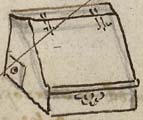 XLI. He beareth a Writing Desk,
Lined or covered with Green Cloth.
The use of this I have said before numb.35.
The Back and Sides.
XLI. He beareth a Writing Desk,
Lined or covered with Green Cloth.
The use of this I have said before numb.35.
The Back and Sides.
The Ledge or Stay, to hold any thing on it.
The Side Drawer, to keep the Writers Necessaries in.
The inner part, for to keep Writings and Papers therein.
The Drawers within, fixt to the back part.
The private Drawers, to keep Rings, Jewels and Money in.
Binding Press
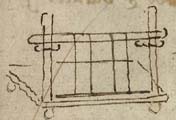 XLII. He beareth a Binding Press.
This is for the Binding and Stitching of single
Sheets of Paper into Books.
XLII. He beareth a Binding Press.
This is for the Binding and Stitching of single
Sheets of Paper into Books.
Related text(s) Binding press parts
Stationer's screw press
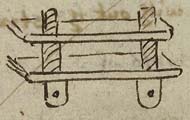 XLIII. He beareth a Stationers, or Bookbinders Screw-Press. When the Books are
stitched together, then these do their office, which is to
press on their covers, and keep them together for the cutting.
XLIII. He beareth a Stationers, or Bookbinders Screw-Press. When the Books are
stitched together, then these do their office, which is to
press on their covers, and keep them together for the cutting.
Related text(s) Screw press parts
Stationer's cutting knife
 XLIV. He beareth a Stationers Cutting Knife or Plow, and a Folding Stick:
The first being to cut the Leaves of the Books even and
smooth; and the other is used for the folding of the
Leaves to prepare them for the Press, it being nothing
else but a flat piece of Ivory or hard Wood with sharp
edges. Of the Plow or Cutting Knife, see it better Engraven and farther described
chap.8. num.164.
XLIV. He beareth a Stationers Cutting Knife or Plow, and a Folding Stick:
The first being to cut the Leaves of the Books even and
smooth; and the other is used for the folding of the
Leaves to prepare them for the Press, it being nothing
else but a flat piece of Ivory or hard Wood with sharp
edges. Of the Plow or Cutting Knife, see it better Engraven and farther described
chap.8. num.164.
Bookbinder's Plow

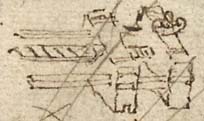 In the chief is the form of the Knife belonging to
the Bookbinders Plow, it is made of Steel, square,
with a square hole in the middle to hold it; from the
outside of which square, proceeds a Tang which ends
in a three square, being Basiled off to a sharp point,
and two edges, which cuts the Paper Leaves as it runs
along with the Plow, or the Rigget of the Press, in
which the Book is held or screwed to be cut.
In the chief is the form of the Knife belonging to
the Bookbinders Plow, it is made of Steel, square,
with a square hole in the middle to hold it; from the
outside of which square, proceeds a Tang which ends
in a three square, being Basiled off to a sharp point,
and two edges, which cuts the Paper Leaves as it runs
along with the Plow, or the Rigget of the Press, in
which the Book is held or screwed to be cut.
Folding hinge
 [Labelled on draft drawings]
Beating stone
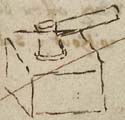 XLV. He beareth a square Beating
Stone; with a Broad faced Hammer upon the Superficies thereof.
XLV. He beareth a square Beating
Stone; with a Broad faced Hammer upon the Superficies thereof.
 Previous section
 Next section
