
2. The next to Joyners, fall (according to the course of the Engravers work) the Instruments and Tools belonging to the Art, Mistery, and Science of Painting; of which I shall say little here, but give you the form of the several Instruments used by them; having already given their terms in the third Chapter of this Book
Drawing desk
 XXIX. He beareth a Drawing Desk.
This is a kind of open Desk by means whereof
any unskillfull in the Art of Drawing, may draw the exact form of any thing printed from copper plates, be it
man or beast, or any Sollid Image, or figure of a thing;
and that with great facility. It is a frame made with hinges joyned to an other board of equall bredth to it, haveing two Stays at the top to raise it higher or lower as
need shall require.
The maner of useing it is thus, fasten the printed figure
fast upon the frame of the Desk; upon it fasten a sheet of clean paper, which upon raising of the frame up upon
the stays, you will see on your white paper the whole
draught of the print so perfectly, that with your pen you
may draw it as accurately as any Limmer whatsoever.
XXIX. He beareth a Drawing Desk.
This is a kind of open Desk by means whereof
any unskillfull in the Art of Drawing, may draw the exact form of any thing printed from copper plates, be it
man or beast, or any Sollid Image, or figure of a thing;
and that with great facility. It is a frame made with hinges joyned to an other board of equall bredth to it, haveing two Stays at the top to raise it higher or lower as
need shall require.
The maner of useing it is thus, fasten the printed figure
fast upon the frame of the Desk; upon it fasten a sheet of clean paper, which upon raising of the frame up upon
the stays, you will see on your white paper the whole
draught of the print so perfectly, that with your pen you
may draw it as accurately as any Limmer whatsoever.
Drawing frame
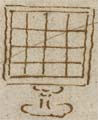 XXX. He beareth a Drawing Frame.
This is a square Frame fixed upon a
round foot, made and crossed into equal squares (as many as you please) with Lute Strings or fine Pack Thrid
which is to be figured at the end of each String, with figures alike; as two sides to have the same, and the
top and bottom answerable. Also there must be a sheet
of paper (or less, as you intend your draught) divided
by lines drawn cross it, with just somany equall squares as
the frame containeth; having the like figures at the end
of the Lines as is upon the frame.
XXX. He beareth a Drawing Frame.
This is a square Frame fixed upon a
round foot, made and crossed into equal squares (as many as you please) with Lute Strings or fine Pack Thrid
which is to be figured at the end of each String, with figures alike; as two sides to have the same, and the
top and bottom answerable. Also there must be a sheet
of paper (or less, as you intend your draught) divided
by lines drawn cross it, with just somany equall squares as
the frame containeth; having the like figures at the end
of the Lines as is upon the frame.
The use is thus, lay the frame on any printed figure as a man, woman, bird, beast, or landskip &c. then with a black lead Pen, draw the same by little and little on the paper, passing from square unto square, with the same lines, as you see the Strings of the frame cross the lines of the Print, or Picture, you are drawing after. It is used also to be set before an Image, or the face of a man, or woman to take the direct dimentions and proportions of them and also to draw little shapes from big ones, by makeing the Squares less on the paper to be drawn; and so on the contrary.
Grinding stone & muller
 XXXI. In this Quarter in the Base is placed a Painters Grinding Stone, with a
Muller upon the superficies thereof. By these two said Stones all sorts of Painters colours are ground fine, either for water or oyl
painting; not by Rubbing the colour by the strength of
Arms, but rather by a slight mannagement of the muller
upon the grinding Stone.
XXXI. In this Quarter in the Base is placed a Painters Grinding Stone, with a
Muller upon the superficies thereof. By these two said Stones all sorts of Painters colours are ground fine, either for water or oyl
painting; not by Rubbing the colour by the strength of
Arms, but rather by a slight mannagement of the muller
upon the grinding Stone.
Painter's pallet and pencils
 The other in Chief is the Painters Pallet, with severall sorts of Colours layd thereon; with a quantity
of Pencills fixed on their Sticks, set in the Hole of
the Pallett, or holding place thereof. After this manner
a Painter when he riseth from his Easell, or Work, he
ever puts his Pencills and Pallett thus together, till he
takes them into his hands again.
The other in Chief is the Painters Pallet, with severall sorts of Colours layd thereon; with a quantity
of Pencills fixed on their Sticks, set in the Hole of
the Pallett, or holding place thereof. After this manner
a Painter when he riseth from his Easell, or Work, he
ever puts his Pencills and Pallett thus together, till he
takes them into his hands again.
The Pallett, is a thin peece of Board, of Cedar wood, Walnut, or Pear tree, or of Horn; about a foot long & 8 or 9 Inches broad, almost like an Egge, at the narrow end of which is made an hole to put the Thumb of the left hand in; near to it is cut a Notch on the out side, by meanes whereof he may hold both the Pallet on the thumb and the Pencills and Rest in the fingers of the same left hand, without trouble. Its use is to hold, mix, and temper colours upon, as the Painter hath occasion to use them.
A Pencill, is a small quantity of Hair, either of Fitchets, Squirrels, or Hogs haire, and such like Stuffe, tyed orderly up, and put into Quills, which quills have Sticks (termed Pencill Sticks) put into them of severall lengths according to their uses; by which the pencill is held to work withall. Of these Pencills there are of all bignesses, from a small Pin, to the compass of a finger of a thumb: what exceeds are generally known by the name of Trenches, Tools, and Laying Brushes, according to their making.
Painter's stay
 Image from proof plate
XXXII. The first is a thing called a Stay or a Rest, of some termed a Mol stick; it is a slender or thin stick made round either of Brazill, or the like, of a yard long, having at one end thereof a little Ball of Cotton, fixed in a piece of Leather of the bigness of a Walnut; its use is when you are at work, you are to hold it in your left hand, and laying the end which hath the Leather ball upon the Cloth or Frame worked upon, you may rest your right Hand or Arm upon it, for the more steadiness thereof whilst you are at work .
Easel
 The second is termed an Easel; it is a Frame made
of Wood (much like a Ladder) somewhat broader at
the bottom than at the top, having a Stay at the back,
the sides flat and full of holes one even with the other,
for which there are to be two Pins of Wood to set your
work upon, and to raise it higher or lower at pleasure; if the work or the frame be small that it will not
reach the Pins, then there is a narrow Board laid over
the Pins, and so the work rests upon it.
The second is termed an Easel; it is a Frame made
of Wood (much like a Ladder) somewhat broader at
the bottom than at the top, having a Stay at the back,
the sides flat and full of holes one even with the other,
for which there are to be two Pins of Wood to set your
work upon, and to raise it higher or lower at pleasure; if the work or the frame be small that it will not
reach the Pins, then there is a narrow Board laid over
the Pins, and so the work rests upon it.
The Easell, is altogether.
The Stay, is that as sets it more upright, or sloping.
The Pins or Peggs.
The Easel Board.
Stenchall
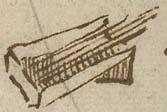 XXIII. He beareth in this quarter; a Stenchal
between a Primeing Knife, and a Painters Laying Brush, but of these in their Orders.
XXIII. He beareth in this quarter; a Stenchal
between a Primeing Knife, and a Painters Laying Brush, but of these in their Orders.
First the Stenchall is a thing made of Tin, about 8 or 10 inches long, and as broad as you please (according to the number of Pencils laid in it) Three sides of it is raised and the fourth is turned downwards, by means whereof in its standing it is raised up higher on one end than the other, which doth make the Oyl put into it, to run all to the lower end: Now the use it is for, is to keep all those Pencils which have been wrought in Oyl soft and molliable, by laying of their points in Oyl contained in the said Tin, which otherwise lying out of Oyl would soon dry and grow hard, and so become good for no use.
Priming knife
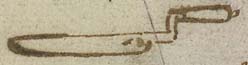 The Priming Knife, it is a kind of Knife with a
broad Blade, and about a Foot or 10 Inches long,
made slender and apt to bend; from the Blade cometh
a crooked Handle (much like a Trowel,) on which
is fixt an Helve or Haft. By this Instrument are all
sorts of Cloths laid over with their first colour, which
is called Primer, from thence this is termed a Priming Knife.
The Priming Knife, it is a kind of Knife with a
broad Blade, and about a Foot or 10 Inches long,
made slender and apt to bend; from the Blade cometh
a crooked Handle (much like a Trowel,) on which
is fixt an Helve or Haft. By this Instrument are all
sorts of Cloths laid over with their first colour, which
is called Primer, from thence this is termed a Priming Knife.
Laying brush
 The Painters Laying Brush; it is of a contrary
nature to Pencils, they being made of fine Hair pointed, and put in Quills or Tins: But these Brushes
are made broad in the end, and of Hogs Bristles
tyed up together about a Handle or Stick to hold
them by while the Colour is laying; of these there ar
several sorts; as, big, and little, answerable to the work
they are to do.
The Painters Laying Brush; it is of a contrary
nature to Pencils, they being made of fine Hair pointed, and put in Quills or Tins: But these Brushes
are made broad in the end, and of Hogs Bristles
tyed up together about a Handle or Stick to hold
them by while the Colour is laying; of these there ar
several sorts; as, big, and little, answerable to the work
they are to do.
Cross compasses
 XXXIV. In this quarter is set a Cross pair of
Compasses, a Pastill, and a Cleansing Pot, of
which in their order.
First the Cross Compasses, of some termed
Cross Dividers, and so called because they are contrary to other Compasses, which are pulled open by the
Tangs, but these are opened by squeesing of them together at the head.
XXXIV. In this quarter is set a Cross pair of
Compasses, a Pastill, and a Cleansing Pot, of
which in their order.
First the Cross Compasses, of some termed
Cross Dividers, and so called because they are contrary to other Compasses, which are pulled open by the
Tangs, but these are opened by squeesing of them together at the head.
Pastil
 Image from proof plate
The Pastil, is that which is set on the dexter side of the Compasses; it is an Instrument used in drawing the first or rude draught of any designed peece before it be coloured; some make them of Chalk, others of Tobacco pipe Clay, others of Plaster of Paris, or of Alabaster Calcined, and with Water made into a Paste then rouled into long pieces (like Black Lead Pencils,) and dryed in the Air, and when you use them, scrape them to a point with a sharp Knife.
Pastils are thus made of several colours to draw withal upon coloured Paper or Parchment; adding that colour you would have them, to the foresaid composition, which in working will imitate the Faces of Men and Women, the Colours of Clouds, Sun Beams, Building and Shadows.
Cleansing pot
 The Cleansing Pot, is either made of Glass, Earth,
or Tin, and hath Oyl in it at all times, to be ready for
the Masters use, and is principally for to cleanse and purify Pencils from the Dregs of such Colours as remain
in them after Oyl work; which is by dipping the ends
into the Oyl, and then gently drawing the same between
your finger and the edge of the Pot or Cup; and the Oyl
will loosen the Colour out of the Pencil, and by degrees
make it as clean as if no colour had been in it.
The Cleansing Pot, is either made of Glass, Earth,
or Tin, and hath Oyl in it at all times, to be ready for
the Masters use, and is principally for to cleanse and purify Pencils from the Dregs of such Colours as remain
in them after Oyl work; which is by dipping the ends
into the Oyl, and then gently drawing the same between
your finger and the edge of the Pot or Cup; and the Oyl
will loosen the Colour out of the Pencil, and by degrees
make it as clean as if no colour had been in it.
Writing desk
 XXXV. He beareth a Desk, or a Writing Desk, with an Open Book upon it.
The Desk is not only to
Write and Read upon, but also to keep things in; having a Drawer in the end, or side thereof, in which is
the Standish for Ink, the Dust Box, and a place
for Pens, Pen-Knife, and Wax, &c.
XXXV. He beareth a Desk, or a Writing Desk, with an Open Book upon it.
The Desk is not only to
Write and Read upon, but also to keep things in; having a Drawer in the end, or side thereof, in which is
the Standish for Ink, the Dust Box, and a place
for Pens, Pen-Knife, and Wax, &c.
 Previous section
 Next section
