
Hatch
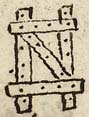 XXXIV. He beareth an Hatch (or a Field
Hatch). This is a diminutive Field Gate, which
is placed in the Hedge to open and shut, only to let a
single Beast in and out of the Field, whether Horse,
Cow or Oxe, and to secure the Pasture from all Trespasses in that place. Also for Milk Maids to go in and
out safely without climing or going over Stiles.
XXXIV. He beareth an Hatch (or a Field
Hatch). This is a diminutive Field Gate, which
is placed in the Hedge to open and shut, only to let a
single Beast in and out of the Field, whether Horse,
Cow or Oxe, and to secure the Pasture from all Trespasses in that place. Also for Milk Maids to go in and
out safely without climing or going over Stiles.
Field gate
 XXXV. He beareth a Field Gate, (or a
Yate).
XXXV. He beareth a Field Gate, (or a
Yate).
Satchel
 XXXVI. He beareth a Setchal or Leather
Bag. This is the Plow
Mans Pantry, in which his provision is put, and carried
on his Shoulder, when he is for the Plow and Harrow.
XXXVI. He beareth a Setchal or Leather
Bag. This is the Plow
Mans Pantry, in which his provision is put, and carried
on his Shoulder, when he is for the Plow and Harrow.
Sack
 XXXVII. He beareth a Sack, or Pough
It is termed a Sack when
it contains 4, 5, or 6 Measures of Corn; a Pough
when it holds 1, 2, or 3; but a Bag when it can hold
but 1, 2, or 3 Pecks.
XXXVII. He beareth a Sack, or Pough
It is termed a Sack when
it contains 4, 5, or 6 Measures of Corn; a Pough
when it holds 1, 2, or 3; but a Bag when it can hold
but 1, 2, or 3 Pecks.
Harvest bottle
 XXXVIII. He beareth an Harvest Bottle.
These Bottles are made
of Coopers Ware, Timber and Hops.
See them under another manner of
way numb.39.
XXXVIII. He beareth an Harvest Bottle.
These Bottles are made
of Coopers Ware, Timber and Hops.
See them under another manner of
way numb.39.
Rack
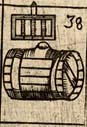 Image from published plate
In the Chief of this quarter is a Rack of 5 Staves. Of some it is termed a Turning Hatch, or Turnstyle gate: Others give it the Denomination of a Grid Iron. Which in my Judgment it most resembleth.
Harvest bottles
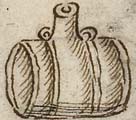 XXXIX. He beareth a Leather Bottle.
Some term it an Harvest Bottle of Leather.
This and the foresaid are kind of Bottles, which the Reapers and Mowers use to carry their Drink or Milk in,
When they are about such Harvest Work.
In the base of this square is another form of an Harvest Bottle, with a kind of Ridged Top, towards the
drinking place.
XXXIX. He beareth a Leather Bottle.
Some term it an Harvest Bottle of Leather.
This and the foresaid are kind of Bottles, which the Reapers and Mowers use to carry their Drink or Milk in,
When they are about such Harvest Work.
In the base of this square is another form of an Harvest Bottle, with a kind of Ridged Top, towards the
drinking place.
Harvest tankard
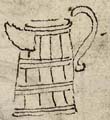 XL. He beareth an Harvest Tankard, or
Harvest Can. Some blazon
it a Tankert with a Mouth peece, or Mouth pipe,
because by it by Harvest people may drink with more ease
then by lifting the whole vessel to their heads.
XL. He beareth an Harvest Tankard, or
Harvest Can. Some blazon
it a Tankert with a Mouth peece, or Mouth pipe,
because by it by Harvest people may drink with more ease
then by lifting the whole vessel to their heads.
Curry comb
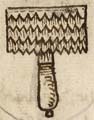 XLI. He beareth a Curry Comb, or an
Horse Comb.
XLI. He beareth a Curry Comb, or an
Horse Comb.
Related text(s) Curry comb parts
Curry comb
 XLII. an Open Curry Comb.
This is an other way of drawing the Horse Comb,
haveing no back, and but one rowe of Teeth.
XLII. an Open Curry Comb.
This is an other way of drawing the Horse Comb,
haveing no back, and but one rowe of Teeth.
Mane comb
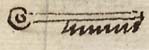 That also in the Chief I take to be an other sort of Curry Comb
used by Grooms, and Ostlers of Stables; to comb and lay
smooth the horse Manes and Tailes: And therefore is
fitly termed the Grooms Mane Comb, or an Horse
Mane Comb.
That also in the Chief I take to be an other sort of Curry Comb
used by Grooms, and Ostlers of Stables; to comb and lay
smooth the horse Manes and Tailes: And therefore is
fitly termed the Grooms Mane Comb, or an Horse
Mane Comb.
Working fork
 XLIII. He beareth a Working Forke,
or a Dung Fork.
This is an Instrument by which Husbandmen Yexon or Mexon, that
is, cleans their Stables, and Cowe houses, from the Beasts
dung, casting it out to the Muck hill: And from thence
with the same Forke, or Yelve, (or Evill as some call
it) cast it into Carts to carry it a way to muck, or manure the ground that is for either pasture or Tillage.
XLIII. He beareth a Working Forke,
or a Dung Fork.
This is an Instrument by which Husbandmen Yexon or Mexon, that
is, cleans their Stables, and Cowe houses, from the Beasts
dung, casting it out to the Muck hill: And from thence
with the same Forke, or Yelve, (or Evill as some call
it) cast it into Carts to carry it a way to muck, or manure the ground that is for either pasture or Tillage.
Related text(s) Yelve parts
Dung forks
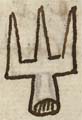
 XLIV. He beareth two Dung Forks, sans
Handles.
XLIV. He beareth two Dung Forks, sans
Handles.
Pick & shovel
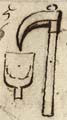 XLV. He beareth a Shovell
and a Pick or Pioneers Pick.
XLV. He beareth a Shovell
and a Pick or Pioneers Pick.
Sieve
 XLVI. He beareth a Sive or Ridle, ...
Hoop
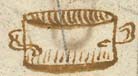 ... and an Hoop.
This
last is also termed a Bushel, Measure, or a Winchester
Measure, or Strick.
... and an Hoop.
This
last is also termed a Bushel, Measure, or a Winchester
Measure, or Strick.
Related text(s) Sieve types Corn measures Strickle Troy weight
Untranscribed item(s) Hebrew measures; Greek measures; Roman measures
Scythe
 Image from proof plate
XLVII. He beareth a German Scythe. Some only give it the name of an Old fashioned Sythe, se others much like this, chap.9. num.135.
Slade
 XLVIII. He beareth a Slade and a
Tumbrell. These are things used by Carters and Husbandmen, for the carriage of Commodities
from place to place.
The first is drawn along the ground by the strength of
horses, from when it is termed a Slade, or Sladge,
because it Slides away. Some call it a Plow Slade.
XLVIII. He beareth a Slade and a
Tumbrell. These are things used by Carters and Husbandmen, for the carriage of Commodities
from place to place.
The first is drawn along the ground by the strength of
horses, from when it is termed a Slade, or Sladge,
because it Slides away. Some call it a Plow Slade.
Tumbrell
 The second termed a Tumbrell, or Muck Car,
or an Horse Cart, is the least sort of Carts, it hath
two wheels, of which I have spoken before num.9. the remaining part of such Carts are these.
The second termed a Tumbrell, or Muck Car,
or an Horse Cart, is the least sort of Carts, it hath
two wheels, of which I have spoken before num.9. the remaining part of such Carts are these.
Related text(s) Drag Cart parts
Waggon
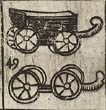 Image from proof plate
XL. He beareth a Waggon and the Wheels and Carriage of a Waggon of the same.
The several parts of a Wagon.
The Shafts, are the two pieces which the hinder
Horse beareth up.
The Welds,
The Slotes, the cross pieces which hold the Shafts
together.
The Bolster, is that on which the fore-Wheels with
the Axle-tree turn in Wheeling the Waggon a cross
Road.
The Chest or Body of the Waggon, having the
Staves and Rails fixed thereon.
The Bushes or Hoops, which compass the top.
The Tilt, is the place covered with Cloth in the
end of the Wagon to sit in, and keep from foul Weather.
All the remaining parts about the Wheels and Axle
Trees, are termed as before in the Cart or Wain.
Waggon wheels
 ... the Wheels and Carriage of a Waggon
 Previous section
 Next section
