
6. Being now outwardly furnished by means of such Instruments as serve for our necessary covering: let us see what Tools are used in Arms by such Trades as support our being, and without which there is no substance; these are principally three, the first is the Butcher, whose Instruments of Slaughter, Blood, Wounds, and Death are as followeth.
Butcher's cambril, skewers and raising prick
 Image from proof plate
XLVII. He beareth Butchers Cambril, between two Scuers, and a Raising prick.
Butcher's axe
 XLVIII. He beareth a Butchers Axe, between his Steel and Knife. The
Butcher or Slaughter man in the Slaughter-house useth
the Axe to strike down Beasts, as Bulls, Cows, Heifers and
Oxen, and by the same Instrument doth divide, cut and
break their Bones: also at the Shambles where they sell
their meat, both the Axe and Cleever are used to cut
the quarter of Beasts into smaller and more vendable
pieces.
XLVIII. He beareth a Butchers Axe, between his Steel and Knife. The
Butcher or Slaughter man in the Slaughter-house useth
the Axe to strike down Beasts, as Bulls, Cows, Heifers and
Oxen, and by the same Instrument doth divide, cut and
break their Bones: also at the Shambles where they sell
their meat, both the Axe and Cleever are used to cut
the quarter of Beasts into smaller and more vendable
pieces.
Butcher's steel
 The Butchers Steel hath a round turning Ring at
the head of the handle by which he hangs it at his Apron
strings on the left side, which is his only badg of being a
Slaughter-Man: upon this Steel, by a nimble and
dexterous way they whet and sharpen the dull edge of the
Slaughter-Knife.
The Butchers Steel hath a round turning Ring at
the head of the handle by which he hangs it at his Apron
strings on the left side, which is his only badg of being a
Slaughter-Man: upon this Steel, by a nimble and
dexterous way they whet and sharpen the dull edge of the
Slaughter-Knife.
Butcher's knife
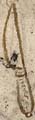
Dutch cleever
 XLIX. He beareth a Dutch Butchers
Cleever, and a Chopping Knife: the Chopping
Knife is to mince and shread Flesh off the Bones,
small for Pyes, and such like use, &c.
XLIX. He beareth a Dutch Butchers
Cleever, and a Chopping Knife: the Chopping
Knife is to mince and shread Flesh off the Bones,
small for Pyes, and such like use, &c.
Chopping knife
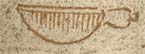 The Dutch Cleever or Chopping Knife, so called by reason it is much born by them in Arms (and
is termed an Hacker, or a Hack-mes) but seldom or
never born with us.
The Dutch Cleever or Chopping Knife, so called by reason it is much born by them in Arms (and
is termed an Hacker, or a Hack-mes) but seldom or
never born with us.
Punching hooks
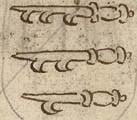 L. He beareth three Punching Hooks,
the first trebble, the second double, and the
third Hooked. By the help of the
Punching Hook, the Skin is with much ease taken off
any Beast, by striking and pricking between the Skin or
Hide, and the Flesh, which causeth a separation between
them.
L. He beareth three Punching Hooks,
the first trebble, the second double, and the
third Hooked. By the help of the
Punching Hook, the Skin is with much ease taken off
any Beast, by striking and pricking between the Skin or
Hide, and the Flesh, which causeth a separation between
them.
Leg of veal
 LI. He beareth on an Hook,
a Leg of Veal.
This is a Cognizance
belonging to the Shambles, and for most Cooks Shops,
either by the thing it self hung in the Window, or by its
shape and figure in a Sign over the Door.
LI. He beareth on an Hook,
a Leg of Veal.
This is a Cognizance
belonging to the Shambles, and for most Cooks Shops,
either by the thing it self hung in the Window, or by its
shape and figure in a Sign over the Door.
Westphalian ham
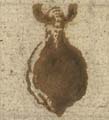 LII. He beareth a Westphalian Ham, hung in
an Iron Staple.
Some term it an Ham of Pork, or a Leg of Bacon
ham-like. The sweetest of Bacons is that which is
said to come from Westphalia, because they are
fed with Walnuts and Chestnuts; many of our English
Cheats with their feeding of Swine, with Pease, Corn
and Acorns (to sweeten the Flesh) besides their Art used
to colour them red, have come very near the Westphalia Ham,
both in colour and taste, yet could never attain the full Skill, and the reason is very plain;
for that we take for Westphalia Bacon, is no other
than the Ham of a Cub, or young Bear, the delicate taste of whose Flesh, our Bacon cannot attain unto by any Art.
LII. He beareth a Westphalian Ham, hung in
an Iron Staple.
Some term it an Ham of Pork, or a Leg of Bacon
ham-like. The sweetest of Bacons is that which is
said to come from Westphalia, because they are
fed with Walnuts and Chestnuts; many of our English
Cheats with their feeding of Swine, with Pease, Corn
and Acorns (to sweeten the Flesh) besides their Art used
to colour them red, have come very near the Westphalia Ham,
both in colour and taste, yet could never attain the full Skill, and the reason is very plain;
for that we take for Westphalia Bacon, is no other
than the Ham of a Cub, or young Bear, the delicate taste of whose Flesh, our Bacon cannot attain unto by any Art.
 Previous section
 Next section
