
2. When the Wool, Flax, and Hemp, hath run through the good Wifes hands, then it is time to set the Weaver to handle his Instruments, and by his Art and Skill of single threds, to make Woven Cloth, which he doth by the help of these Tools following.
Weavers reeds
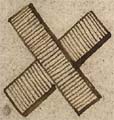 XXI. He beareth two Weavers Reeds.
This is an Instrument belonging to the Trade of a
Weaver, it is made of slit Cane, for the Weaving of
round or course Cloth, but for fine Cloth, of Reeds. It
hath these parts belonging to it.
XXI. He beareth two Weavers Reeds.
This is an Instrument belonging to the Trade of a
Weaver, it is made of slit Cane, for the Weaving of
round or course Cloth, but for fine Cloth, of Reeds. It
hath these parts belonging to it.
The Brier, are the two out side to which the middle Reeds or Canes are fixed.
The Whipping, is the Pack-thred turned round about the Brier to hold them together.
The Reed, is the middle part of it, where the Cane is set one by one at a little distance.
The Cospe, is the flat and smooth ends.
Shuttle
 XXII. He beareth a Weavers Shuttle
between a Thrum and a Preme.
These are things belonging to the Weavers Occupation, and of great use.
XXII. He beareth a Weavers Shuttle
between a Thrum and a Preme.
These are things belonging to the Weavers Occupation, and of great use.
Thrum
 Image from published plate
The Thrum is that as the Web is tied to (or knit too as they term it) which is only ends of Yarn coming out above five or six Inches or more, of a narrow piece of cloth, in which the ends are Woven: which narrow piece is termed the Fent of the Thrum.
Preem
 The Preme, is made of white Wands, this is for the
opening of the Yarn from the Beam on which it is rowled,
if it comes off thence foulded, or run one upon another:
so that each thred may pass clearly through the Reed.
The Preme, is made of white Wands, this is for the
opening of the Yarn from the Beam on which it is rowled,
if it comes off thence foulded, or run one upon another:
so that each thred may pass clearly through the Reed.
Shuttle
 XXIII. He beareth a Weaver's Shuttle,
Tipped and Furnished with a Quill of
Yarn, the Threds pendant. Others say thus,
A Shuttle tipped and set with a Quill or Pin of
Thred, the end pendant.
XXIII. He beareth a Weaver's Shuttle,
Tipped and Furnished with a Quill of
Yarn, the Threds pendant. Others say thus,
A Shuttle tipped and set with a Quill or Pin of
Thred, the end pendant.
Preem (old form)
 In the Base of this Quarter I have caused a Weavers
Preeme to be set, to show the difference of its draught,
this being the form in which it was anciently made, the
foregoing being our modern one, and in use now.
In the Base of this Quarter I have caused a Weavers
Preeme to be set, to show the difference of its draught,
this being the form in which it was anciently made, the
foregoing being our modern one, and in use now.
Related text(s) Shuttle parts
Distaffs
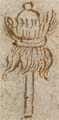
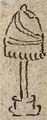 XXIV. He beareth a Distaff, with a Disoning of Flax tied about it. This is our Countrey way of tying Flax about the Distaff.
To the Distaff there belongs a Stand, to which it is fixed by those as Spin at the sitting Wheel; the form of it I have set at the sinister side of its Distaff: It is constantly fixed in an hole, made purposely behind the Bosse or Cup, which holds the Spindle and Maidens on, near the corner of the Wheel stock: all the parts are thus termed.
The Distaff Body, is the Standard set in the Whel stock.
The Over-cross Piece, is that fixt into a hole of the top of it.
The Distaff Shank or Arse, is set in a hole of the over cross piece.
The Distaff Head, that as hath the Tow rowled about it.
The Button on the Head, at which an Inkle, or Fillet, or String is tied for to rowle about the Flax or Tow, to keep it on.
In the Dexter Base of this Quarter, is another way of drawing the Distaff tied about with Flax, or Hemp: the Distaff String or Fillet drawn orderly about it, to keep the Flax in a Handsome equipage, for its drawing out to Spin.
Havits


 XXV. He bears two Havits
(or Tuidern Irons, or Clothiers
Bench Hooks) to shew the several ways I have seen
them made in Coats of Arms, and yet none right for the
hooks at the ends should stand more streighter out, not
turning inwards.
XXV. He bears two Havits
(or Tuidern Irons, or Clothiers
Bench Hooks) to shew the several ways I have seen
them made in Coats of Arms, and yet none right for the
hooks at the ends should stand more streighter out, not
turning inwards.
Handle
 XXVI. He beareth a Clothiers working
Tassel. It is so termed of old, but the Workmen
themselves call it (being thus furnished and set with
Tassels) an Handle: and having no Tassels, is termed
an Handle Stock.
XXVI. He beareth a Clothiers working
Tassel. It is so termed of old, but the Workmen
themselves call it (being thus furnished and set with
Tassels) an Handle: and having no Tassels, is termed
an Handle Stock.
Shearmens shears
 XXVII. He beareth a Pair of Shearmans Shears.
Wool shears
 XXVIII. He beareth a Pair of Wool
Shears. There are several sorts of Wool Shears, these being the shape of
them which are generally used by the Wet-Glovers for
the cutting of those Knots and hard Locks, which they
find in their Fleeces of Wool.
XXVIII. He beareth a Pair of Wool
Shears. There are several sorts of Wool Shears, these being the shape of
them which are generally used by the Wet-Glovers for
the cutting of those Knots and hard Locks, which they
find in their Fleeces of Wool.
These Shears upon constant and daily use, are by a Leather band kept close together, else they are apt to fly too much open by reason of the strength of the head, which is a spring; which would in a little time of working, strain and benum the hand. But by this Leather Socket, it puts a check to it, and keeps it from flying out, as you see in the Figure, which may be termed a Pair of Wool Shears Bridled.
Preen
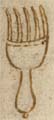
 XXIX. He beareth a Preene: this is an
Instrument used by the Clothworkers, and is for their Handle Dressing, or picking of the Wool Flocks,
which comes off a piece of Cloth in the Rowing of it;
It is an half round piece of Wood, with a handle at it, the
streight side being set with Wyers like teeth about an Inch
and half long.
XXIX. He beareth a Preene: this is an
Instrument used by the Clothworkers, and is for their Handle Dressing, or picking of the Wool Flocks,
which comes off a piece of Cloth in the Rowing of it;
It is an half round piece of Wood, with a handle at it, the
streight side being set with Wyers like teeth about an Inch
and half long.
Napkin
 XXX. He beareth a Piece of Cloth.
This piece of Cloth is (as it were) cast over the Arm,
as serving Men do their Napkins when they waite at
the Table, in feasting time: so that if it be born white it
may not unfitly be termed either a Towel or a Napkin.
XXX. He beareth a Piece of Cloth.
This piece of Cloth is (as it were) cast over the Arm,
as serving Men do their Napkins when they waite at
the Table, in feasting time: so that if it be born white it
may not unfitly be termed either a Towel or a Napkin.
Cloth
 XXXI. He beareth a piece of Cloth
foulded up, the List of selvage [shown a different colour].
XXXI. He beareth a piece of Cloth
foulded up, the List of selvage [shown a different colour].
Twisting wheel
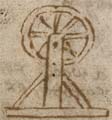 XXXII. He beareth a Button makers twisting Wheel. This is also termed a Rope makers
Wheel, but that is more exactly set forth, chap.5.
numb.171.
XXXII. He beareth a Button makers twisting Wheel. This is also termed a Rope makers
Wheel, but that is more exactly set forth, chap.5.
numb.171.
 Previous section
 Next section
