
CHAP. VI.
1. Having in the former Chapters Treated of several Trads and Occupations, with the manner of their Bearings in Coats of Arms; as also the Chief of their Terms of Art, used by them. I shall now proceed to give some examples of Mechanick Tools and Instruments, together with such as pertain to the several Mysteries and Occupations depending upon the Liberal Sciences. We shall therefore begin with those things which are for meer Necessity, such as Clothing, Meat and Drink &c. which how meanly soever they be reckoned to the bearing of other things, yet nevertheless it is clear that these Tools and Instruments (no less then those) do proceed from the Immediate Gift of God. Therefore there is but little reason for their contempt, but rather the contrary: seeing they do express Trads so much behoveful for the use and knowledge, issued out of the Plentiful Fountain of Gods abundant Spirit.
Spinning Book III, Chapter 6, Section 1a
We do begin then first with the Instruments belonging to the House-wife: for the Spinning of Wool, Flax, and Hemp.
Fleece of Wool
 I. He beareth a Fleece of Wool.
A Fleece is as much Wool as is taken of the back of one Sheep, therefore it is, that some are large, and other small: because it groweth better on one Sheep than another. So it is in the Wool, some are of a fine growth, Soft and Gentle, others are more harsh and hairy.
Wool pack
 II. He beareth a Wool Pack.
This is a great number of fleeces made up together in a cloth tied up at the four ends or corners.
Wool pack
 III. He beareth a Wool-Pack.
The like bearing to this is born by the Company of Dyers in the City of Chester: yet for that Company they are termed three Bailes of Madder; that being a kind of dying stuff which they use, and so being born according to other Trades it ought to be termed, as
A Bundle,
A Trusse,
A Fardel,
A Baile of Madder,
A Pack of Wool, Cloth, Hops.
Swingle hand
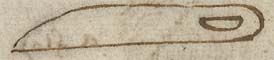 IV. He beareth a Swingle Hand erected,
Surmounting of a Swingle Foot. This
is a Wooden Instrument made like a Fauchion, with
an hole cut in the top of it, to hold it by: It is used for
the clearing of Hemp and Flax from the large broken
Stalks or Shoves by the help of the said Swingle Foot,
which it is hung upon, which said Stalks being first
broken, bruised, and cut into shivers, by a Brake.
IV. He beareth a Swingle Hand erected,
Surmounting of a Swingle Foot. This
is a Wooden Instrument made like a Fauchion, with
an hole cut in the top of it, to hold it by: It is used for
the clearing of Hemp and Flax from the large broken
Stalks or Shoves by the help of the said Swingle Foot,
which it is hung upon, which said Stalks being first
broken, bruised, and cut into shivers, by a Brake.
Swingle foot
 Image from published plate
Wool card
 V. He beareth a Wool-Card.
These are termed Wool-Cards, from their Carding of Wool, whose Teeth then are made short, and set thick together for strength. Flax-Cards, requires no such strength in them therefore the Teeth are set in longer, and thinner.
Flax or hemp brake
 Image from published plate
In the Dexter base of this Quarter, is another sort of a Flax or Hemp Brake, made of a contrary way to that in the succeeding square, numb.6. and in truth is the right shape of it.
Related text(s) Card parts Cardmaker's terms
Flax brake
 VI. He beareth a Flax Brake. This
is an Instrument of Housewifery, by which both Flax
and Hemp are first broken from the strong Stalks into
large Shoves or Shivers.
VI. He beareth a Flax Brake. This
is an Instrument of Housewifery, by which both Flax
and Hemp are first broken from the strong Stalks into
large Shoves or Shivers.
A Flax or Hemp Brake, is a logg of Wood cut along with Teeth like a Saw; having a like piece of Wood cut into Teeth, which falls into the under Teeth being fastned at the end with a hinge, it hath liberty to rise and fall at one end, between which Teeth the Flax being put the Teeth bruise and breaks the hard husk of the stalk all into shivers.
Stock card
 VII. He beareth a Stock-Card.
The Stock-Card, is of the same nature as the
Wool Card, only of a larger size, having a double
handle fixt on the middle of the Board, by which the
Workman holdeth with both Hands, and so Cards
Wool (for it is only for Wool) upon another such like
Card, but larger, fastned upon a Board or Bench set
upon four strong and weighty Feet, not easily to be moved or drawn over.
The London Herralds draw the Bayers Flote, by
which Bows are made, after the form of this stock Card,
which is a great error, see it chap.8. numb.122. 125.
VII. He beareth a Stock-Card.
The Stock-Card, is of the same nature as the
Wool Card, only of a larger size, having a double
handle fixt on the middle of the Board, by which the
Workman holdeth with both Hands, and so Cards
Wool (for it is only for Wool) upon another such like
Card, but larger, fastned upon a Board or Bench set
upon four strong and weighty Feet, not easily to be moved or drawn over.
The London Herralds draw the Bayers Flote, by
which Bows are made, after the form of this stock Card,
which is a great error, see it chap.8. numb.122. 125.
Hatchel
 VIII. He beareth an Hatchel.
[It] may be termed only an Hatchel, or a Flax Comb, or Flax Card. There are several sorts of Hatchels used by Housewives for the making of Flax, from one degree of fineness to another; and that is by the fineness and closeness of the teeth set one to another: as,
The Round or Course Hatchel, which is long and wide toothed.
The Fine Hatchel, which is short and close toothed.
Wool comb

 IX. He beareth a Wool Comb (or a Jersy
Comb).
This Jersy Comb, is the way of drawing it by our
modern Heralds, which hath some resemblance to the
true shape of it, yet differeth, but not so much as the other Comb set forth in the Base of this Quarter, and also
in number 10 following, which were the form and shapes
of them drawn of old.
IX. He beareth a Wool Comb (or a Jersy
Comb).
This Jersy Comb, is the way of drawing it by our
modern Heralds, which hath some resemblance to the
true shape of it, yet differeth, but not so much as the other Comb set forth in the Base of this Quarter, and also
in number 10 following, which were the form and shapes
of them drawn of old.
Related text(s) Jersey comber's terms
Jersey comb
 X. This is the old way of Drawing the Wool, or
Jersy Comb, which I have caused to be set here, that
it may be seen what a difference there is between them
used of old, and those in our Days, as that set in the
Chief of this Square which is the true form of the Jersy
Comb used now by those kind of Workmen.
X. This is the old way of Drawing the Wool, or
Jersy Comb, which I have caused to be set here, that
it may be seen what a difference there is between them
used of old, and those in our Days, as that set in the
Chief of this Square which is the true form of the Jersy
Comb used now by those kind of Workmen.
True form of jersey comb
 Image from published plate
 Next section
