
Jacket
 XX. He beareth a Jacket, or Loose Coat,
Lined. This Coat I have observed to
be in a London Sign, which was only to shew, and give
notice that a Man-taylor lived in the same House.
XX. He beareth a Jacket, or Loose Coat,
Lined. This Coat I have observed to
be in a London Sign, which was only to shew, and give
notice that a Man-taylor lived in the same House.
Cordy robe
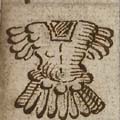 XXI. He beareth a Roman Garment.
Some call it a Cordy Robe Garment, because
it was the ancient fashion of the old Romans to have such
Labells hanging at the shoulder Wings, and from under
the skirts of their Body Garment, which they call Cordilans and Cordy Robes.
XXI. He beareth a Roman Garment.
Some call it a Cordy Robe Garment, because
it was the ancient fashion of the old Romans to have such
Labells hanging at the shoulder Wings, and from under
the skirts of their Body Garment, which they call Cordilans and Cordy Robes.
Boys Coat
 XXII. He beareth a Boys Coat; Lined. This is the last of Coats used for Boyes,
after which they are put into Breeches. If it had hanging
Sleeves, then we term it a Childs Coat.
XXII. He beareth a Boys Coat; Lined. This is the last of Coats used for Boyes,
after which they are put into Breeches. If it had hanging
Sleeves, then we term it a Childs Coat.
Related text(s) Coat parts
Vest
 XXIII. He beareth a Vest; Lined.
This was the form of the Russian Embassedors
loose Coat when he came first to England, shortly after
King Charles the Seconds return from Exile, which Garb
was so taken too, that it became a great fashion and wear,
both in Court, City and Country. The Several parts
of this Fashion are these:
XXIII. He beareth a Vest; Lined.
This was the form of the Russian Embassedors
loose Coat when he came first to England, shortly after
King Charles the Seconds return from Exile, which Garb
was so taken too, that it became a great fashion and wear,
both in Court, City and Country. The Several parts
of this Fashion are these:
The Vest, a side deep loose Coat almost to the Feet with short sleeves.
The Tunick, a close bodied Coat, the skirts of it being down to the Knees.
The Sash, the Girdle by which the Tunick was tied to the Body, so called because it hath a round Button and Tassel hanging at the ends of it.
The Zoan, is a girdle of Silk. without Buttons and Tassels, which is tied in a bow knot before.
Mandilion
 XXIV. He beareth a Mandilion; this
was a kind of loose Coat worn upon a Dublet either
Buttoned, or open: and much in use in the Reign of
Queen Elizabeth: It had no Sleeves, but two broad
Wings on the Shoulders, and hanging Sleeves at the
Back: with side Skirts, or Laps.
XXIV. He beareth a Mandilion; this
was a kind of loose Coat worn upon a Dublet either
Buttoned, or open: and much in use in the Reign of
Queen Elizabeth: It had no Sleeves, but two broad
Wings on the Shoulders, and hanging Sleeves at the
Back: with side Skirts, or Laps.
Gown
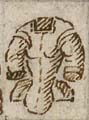 XXV. He beareth the Body of a Womans
Gown to open before. Some term it a Gown
Body with close Sleeves, a Peak down before, and
cordy Robe Skirts.
XXV. He beareth the Body of a Womans
Gown to open before. Some term it a Gown
Body with close Sleeves, a Peak down before, and
cordy Robe Skirts.
Childs coat
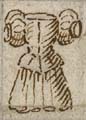 XXVI. He beareth a Child, or Boys Coat
with round or ruffed Sleeves: This is the last
of Coats that Boys about five or six Years of age use to
wear, after which they are put into Breeches and Doublets. There is another fashion as numb.22. used for
Children. Such Coats as these are often painted on signs,
and on cloths, to shew where Taylors, Salesmen, and Brokers live, or keep their Shops.
XXVI. He beareth a Child, or Boys Coat
with round or ruffed Sleeves: This is the last
of Coats that Boys about five or six Years of age use to
wear, after which they are put into Breeches and Doublets. There is another fashion as numb.22. used for
Children. Such Coats as these are often painted on signs,
and on cloths, to shew where Taylors, Salesmen, and Brokers live, or keep their Shops.
Semar
 XXVII. He beareth a Semeare.
This is a kind of loose Garment without
and stiffe Bodies under them, and was a great fashion for
Women about the Year 1676. Some call them Mantuas, they have very short Sleeves, nay some of the
Gallants of the times, have the Sleeves gathered up to the
top of the Shoulders and there stayed, or fastned with a
Button and Loope, or set with a rich Jewel.
XXVII. He beareth a Semeare.
This is a kind of loose Garment without
and stiffe Bodies under them, and was a great fashion for
Women about the Year 1676. Some call them Mantuas, they have very short Sleeves, nay some of the
Gallants of the times, have the Sleeves gathered up to the
top of the Shoulders and there stayed, or fastned with a
Button and Loope, or set with a rich Jewel.
Doublet
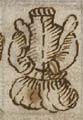 XXVIII. He beareth an High Winged
Doublet and short Skirts with Trunk, or Sailors
Breeches. This was the fashion of the Gentry
in the beginning of King James his Reign: the sleeves
being either slashed or pinked as they then called it;
and the Breeches so full in the wast, that they fell into
Pleats and Folds, and being gathered at the Knees, they
swelled round out: as in many Monuments to be seen,
where they are tied above the Knees, and the hose also
gathered under the Knees.
XXVIII. He beareth an High Winged
Doublet and short Skirts with Trunk, or Sailors
Breeches. This was the fashion of the Gentry
in the beginning of King James his Reign: the sleeves
being either slashed or pinked as they then called it;
and the Breeches so full in the wast, that they fell into
Pleats and Folds, and being gathered at the Knees, they
swelled round out: as in many Monuments to be seen,
where they are tied above the Knees, and the hose also
gathered under the Knees.
Breeches
 XXIX. He beareth a pair of Trunk Breeches. These were much in use with the Gentry
and Nobility in the time of King Henry Eight, as
pictures of those times manifest, and also the latter end of
Queen Elizabeth, and beginning of King James. But now
they are cast out of Door, by them, and only worn by
Pages of Honor, and Pages of great Estates.
XXIX. He beareth a pair of Trunk Breeches. These were much in use with the Gentry
and Nobility in the time of King Henry Eight, as
pictures of those times manifest, and also the latter end of
Queen Elizabeth, and beginning of King James. But now
they are cast out of Door, by them, and only worn by
Pages of Honor, and Pages of great Estates.
Kings robe
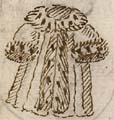 XXX. He beareth a Kings Parliament
Robe; lined and turned up Ermine. This is
more briefly blazoned a Kings Robe, a Robe of Estate, or a Parliament Robe; the colour and furring
ever as aforesaid, if it be otherwise then to be mentioned, as in the next example.
XXX. He beareth a Kings Parliament
Robe; lined and turned up Ermine. This is
more briefly blazoned a Kings Robe, a Robe of Estate, or a Parliament Robe; the colour and furring
ever as aforesaid, if it be otherwise then to be mentioned, as in the next example.
Two such Robes, and a Royal Tent; pertaineth to the Coat of the Worshipful Company of Merchant-Taylors as a part thereof.
Robe of estate
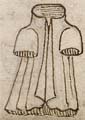
Mantle of estate

Tassel
 XXXIII. He beareth a Tassel.
The Mantle of Estate shewed
you before, is garnished with strings tasselled, which
kind of tasselling is also used to diverse other strings or
Cordons of Creation, Robes, or Mantles, as to the
habits of the Prince of Wales, nights of the Garter &c.
when they have their whole abiliment upon the.
XXXIII. He beareth a Tassel.
The Mantle of Estate shewed
you before, is garnished with strings tasselled, which
kind of tasselling is also used to diverse other strings or
Cordons of Creation, Robes, or Mantles, as to the
habits of the Prince of Wales, nights of the Garter &c.
when they have their whole abiliment upon the.
Cloak
 XXXIV. He beareth a Cloak Faced
and Caped.
XXXIV. He beareth a Cloak Faced
and Caped.
The Cloak is round in compass, and by having a Cape is distinguished from another sort of covering without a Cape, called a Rocket, or a Mantle.
Cloak
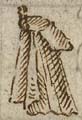 XXXV. He beareth a Cloak hanging by
its Button.
XXXV. He beareth a Cloak hanging by
its Button.
Herald's coat
 XXXVI. He beareth an Heralds Coat Adorned with the Soveraigns Coat of Armes; and fringed about.
Three such Coats make an accomplished Herald, viz. the Pursuivant, the Heraught and the King of Arms,
after whom there is no superior in that Colledge of Officers.
XXXVI. He beareth an Heralds Coat Adorned with the Soveraigns Coat of Armes; and fringed about.
Three such Coats make an accomplished Herald, viz. the Pursuivant, the Heraught and the King of Arms,
after whom there is no superior in that Colledge of Officers.
Pall

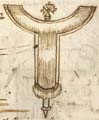 XXXVII. He beareth a Pall edged, fringed, and imbrauthered with Estoiles.
Cope
 XXXVIII. He beareth a Cope (or a Priests Cope), lined, fringed, edged and imbrauthered with a long Cross (or Christs Cross) and
four Etoiles. This is the Romish Priests Vestment, which was cast over the Serplice when he served at the Alter.
XXXVIII. He beareth a Cope (or a Priests Cope), lined, fringed, edged and imbrauthered with a long Cross (or Christs Cross) and
four Etoiles. This is the Romish Priests Vestment, which was cast over the Serplice when he served at the Alter.
Liveryman's Hood
 XXIX. He beareth a Livery Mans hood,
or Tippet.
XXIX. He beareth a Livery Mans hood,
or Tippet.
Some say, counterchanged, the one of the other, this was a kind of Hood, which the Masters and Stewards of Incorporated Societies, and Companies (about the beginning of Henry the Eight his Reign, and in former times) did wear upon their heads in publick meeting, and assemblies; to shew that they were the chief in office in those Societies. But about the beginning of Queen Elizabeths Reign, they then cast then off their heads, and hung them on their shoulders; in which order, the Masters, Livery Men, or Stewards of all Companys with us, wear them at all publick meetings to this day.
They are called a Stewards Tippet, or Livery Hood: a Hood from its being worn on the head, and a Tippet from the long tail or train which hanged behind almost to the Ground. These kind of hoods (but all black) are to this day worn by close Mourners at the Solemnities of great Funerals, every person according to his degree, having the Tippet or Trail thereof, longer or shorter: some to the middle of the back, others to the thighs, others to the ground, and the chief Mourners, and assistance trailing on the ground.
Girdle
 XL. He beareth a Girdle Imbrauthered, or Garnish, and Hook and Hasp: in base
a Turks, or Russian Girdle, or Towel tied in a
Bow Knot.
XL. He beareth a Girdle Imbrauthered, or Garnish, and Hook and Hasp: in base
a Turks, or Russian Girdle, or Towel tied in a
Bow Knot.
The first of these were a great fashion in the beginning of my days, but now clearly laid aside: the other in use in those Countrys to this day.
Turk's girdle

Scarf
 XLI. He beareth a Scarfe tied up
and Fringed about. Others do say, a Scarfe,
tied up with a Ribbon of Gold.
But all this needs not, seeing both shoulder or middle wast Scarfs worn by Commanders, and Field Officers,
have their Scarfs generally so Fringed with Silver or Gold,
or both.
But such Scarfes as are worn at Funerals, have none
at all but tied up with a Ribbon: the Scarfes being black
at the Death of a married person, and white at an unmarried.
XLI. He beareth a Scarfe tied up
and Fringed about. Others do say, a Scarfe,
tied up with a Ribbon of Gold.
But all this needs not, seeing both shoulder or middle wast Scarfs worn by Commanders, and Field Officers,
have their Scarfs generally so Fringed with Silver or Gold,
or both.
But such Scarfes as are worn at Funerals, have none
at all but tied up with a Ribbon: the Scarfes being black
at the Death of a married person, and white at an unmarried.
Garter
 XLII. He beareth a Garter or Ribbon: with the Badge of St George on horse back, slaying of a Dragon: having
Drops or Jewels pendant. This is the sign or token by which a Knight of the Garter is manifest by having about his Neck
a blew Ribbon, with the foresaid Jewel hanging thereat. ...
XLII. He beareth a Garter or Ribbon: with the Badge of St George on horse back, slaying of a Dragon: having
Drops or Jewels pendant. This is the sign or token by which a Knight of the Garter is manifest by having about his Neck
a blew Ribbon, with the foresaid Jewel hanging thereat. ...
Belt
 XLIII. He beareth a Belt in pale
fringed about the edges, studded, and buckled, having a Sword hanging therein.
See the terms of the several parts of a Sword
Scabard and Belt in chap.18. numb.21.
XLIII. He beareth a Belt in pale
fringed about the edges, studded, and buckled, having a Sword hanging therein.
See the terms of the several parts of a Sword
Scabard and Belt in chap.18. numb.21.
Jacket (?) and hood
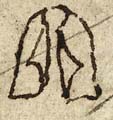
 [Two unidentified drawings of clothing]
 Previous section
 Next section
